What Is a Virality Predictor (and What It Can’t Do)
An honest virality predictor reads your video's creative structure before you post — so you fix the weak second instead of guessing.
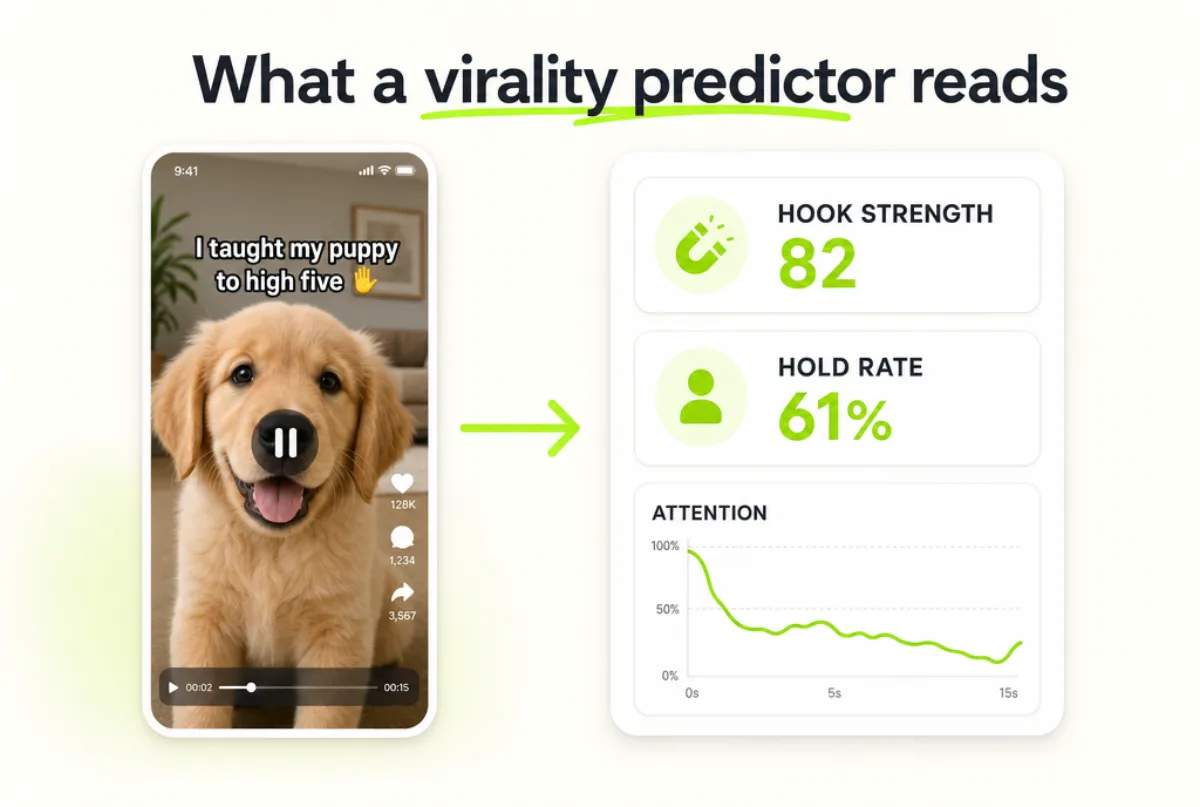
A virality predictor estimates, before you post, whether a short video is built to stop the scroll and hold attention. The honest ones read the clip — not your view count.
TL;DR — A real virality predictor is a creative diagnostic that points at the second your video loses people. It can't see your followers, the algorithm, or luck — and the good ones say so.
🧠 What it actually is
Strip the marketing and it's a measurement instrument for the creative layer of a video — the part inside the file itself.
It opens your clip the way a viewer's attention does: frame by frame, sound and image together.
Then it turns what it sees into signals you can act on.
It has never seen your account. It doesn't know what's trending. All it reads is the footage — which is the one variable you fully control.
Think flight simulator, not fortune teller. It can't promise good weather on launch day.
It can tell you the wings are on backwards.
📈 What it measures
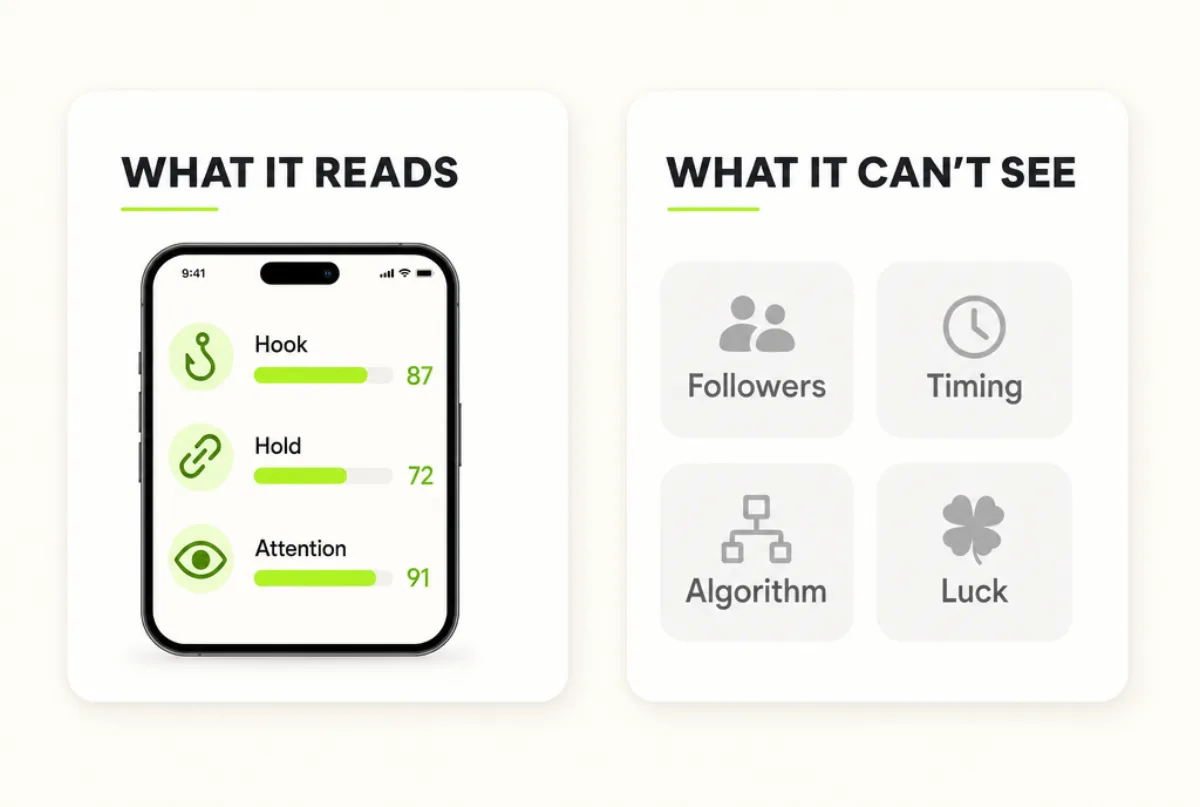
An honest predictor reads measurable signal straight from the footage. Scrollproof splits it into four readouts:
- Hook strength — how hard the first second interrupts the scroll. The highest-leverage moment in any short video. (The first second is the whole negotiation.)
- Hold rate — predicted retention across the clip, especially the sagging middle where most videos quietly bleed viewers.
- Attention curve — a second-by-second estimate of where focus rises and drifts, so a dip gets a timestamp. (How to read an attention curve.)
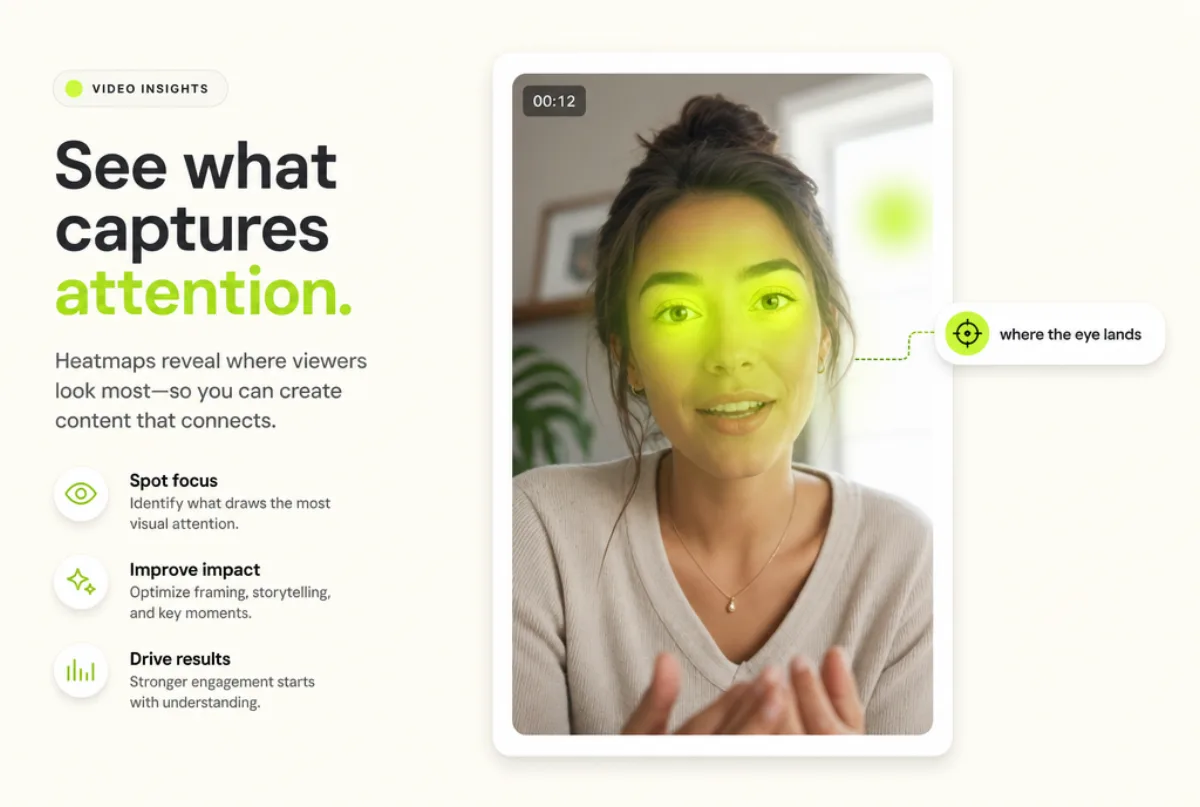
- Visual attention — where the eye is likely pulled on each key frame, from a visual-saliency model.
These aren't vibes. They come from real computer-vision and audio analysis — saliency, motion, scene cuts, audio energy, face presence — blended into a transparent composite.
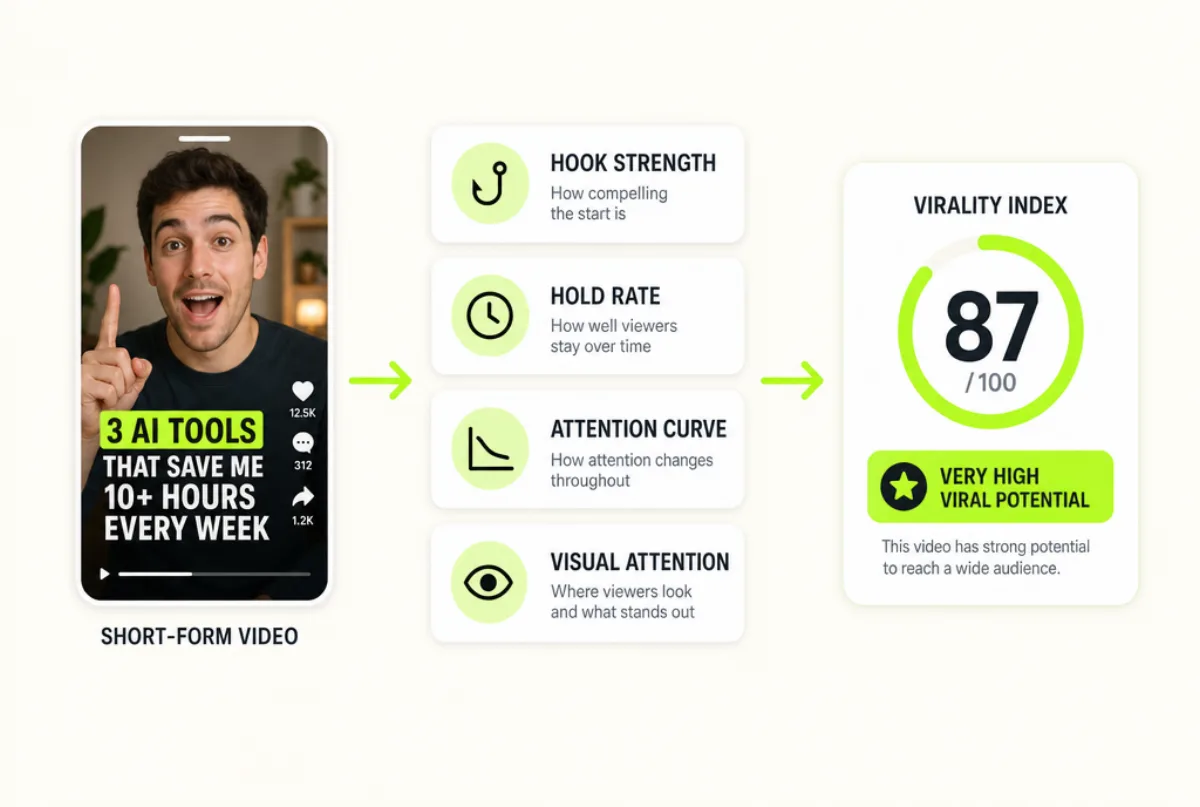 A virality predictor reads four measurable channels from the footage and blends them into one transparent composite.
Hook and hold are separated on purpose. Stopping the scroll and keeping someone watching are two different jobs that fail for different reasons. Hook vs. hold breaks down why a clip can ace one and flunk the other.
✅ How the score gets built
Here's where honest and dishonest tools split hard. A black-box predictor hands you a number and a feeling — and when it's wrong, you learn nothing.
A transparent one maps every readout to a channel you can point at.
| Signal | What it means | Quick fix |
|---|---|---|
| Weak hook | Low visual saliency or flat audio in the opening frames | Lead with the payoff; cut the slow intro |
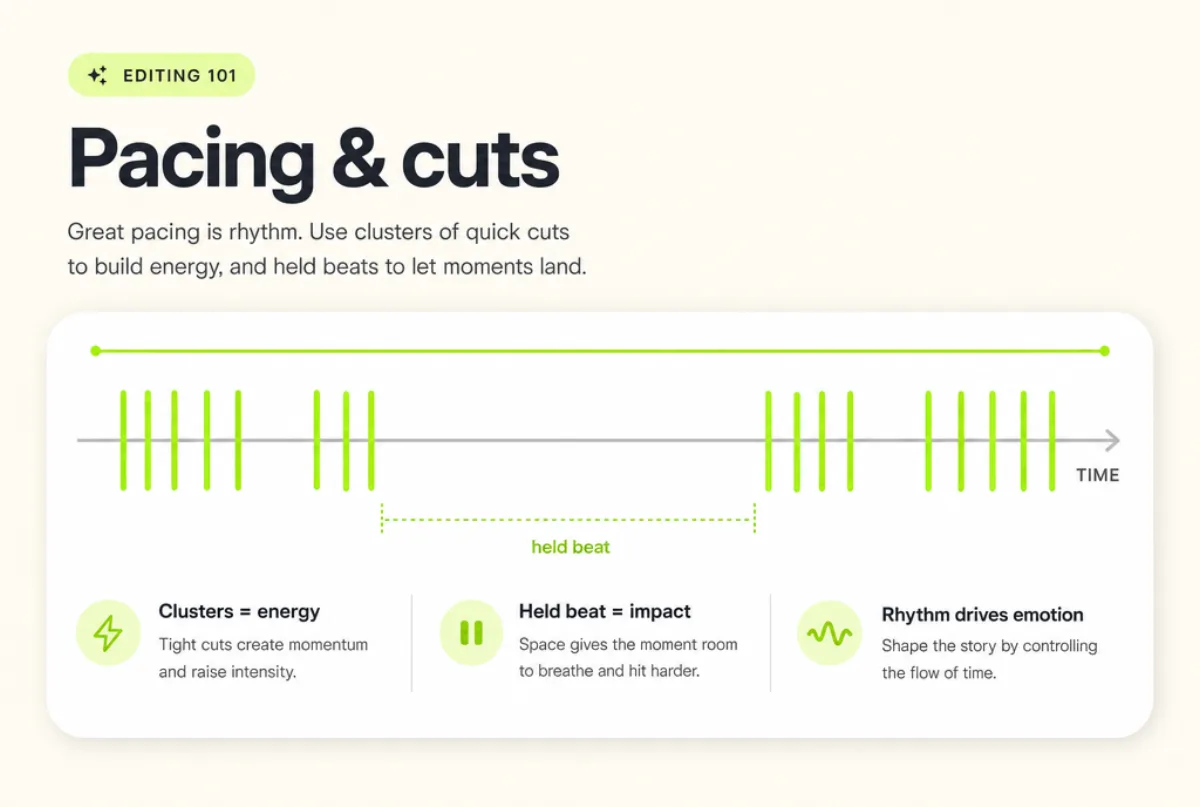
| Sagging hold | A long stretch with no cut, no motion, no audio change | Add a cut or pace change to the dead patch |
| Curve dip at 0:06 | A specific cut lands on a static frame | Re-time the cut; give the eye somewhere to go |
| Flat audio | Sound carries no energy or change | Treat sound as half the video |
The composite is a weighted blend of measured channels, not a magic constant. Because every part is observable, you can argue with it — and that's the feature. We go deeper in what a virality score can and can't tell you.
❌ What it can't do
It's worth naming the limits, because limits are where dishonest tools do their best lying.
- It can't see your distribution. Followers, timing, and how the algorithm pushes or buries you are all downstream of publishing.
- It can't judge your idea. It reads craft, not concept. Your open can be sharp and the idea can still be one nobody wants.
- It can't read culture or timing. It doesn't know your trend peaked three days ago. It reads the file, not the feed.
- It isn't a brain scan. The heatmap is a saliency model of where the eye is likely pulled — not an fMRI or EEG. "Brain-style" is a metaphor for the math.
No tool can guarantee a video goes viral. Virality also depends on account size, posting time, the algorithm's mood, the topic's moment, and plain luck — none of which live in the file. Anything promising "guaranteed views" is selling certainty that doesn't exist.
A virality predictor is a spell-checker for retention. It catches the typo. It doesn't tell you the essay was worth writing.
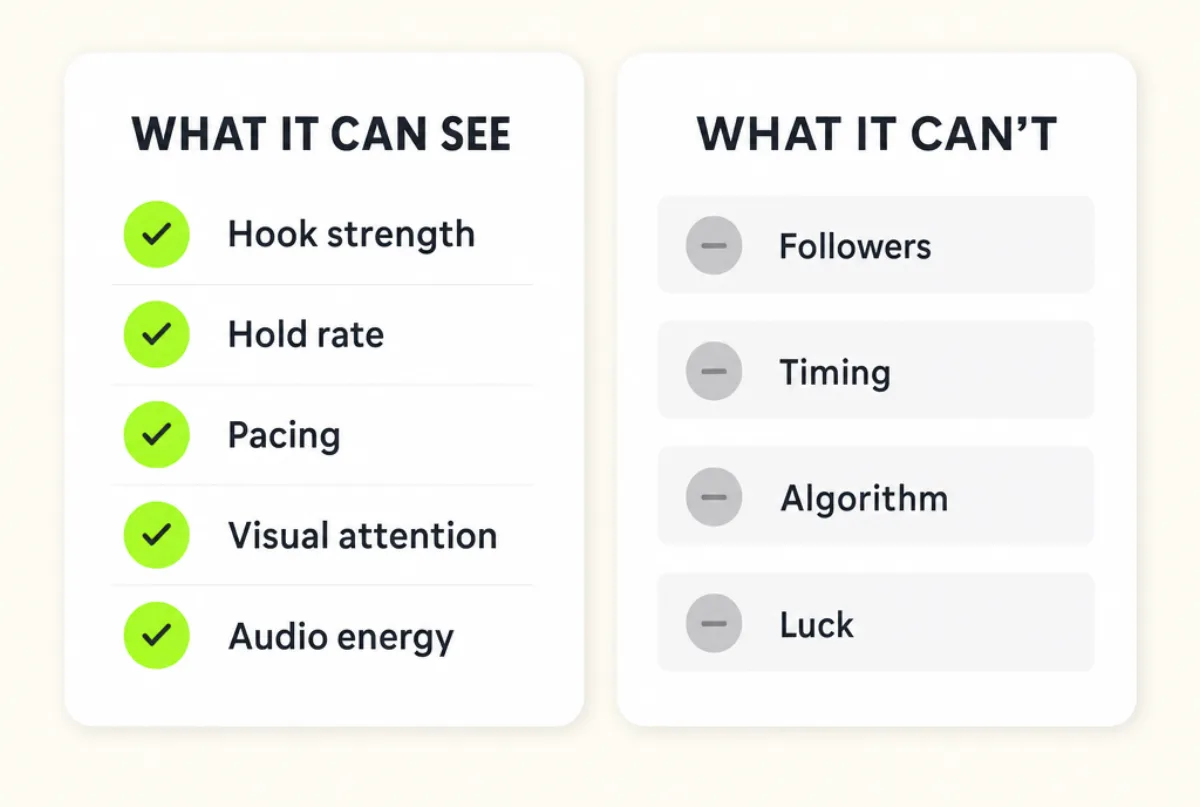 A pre-publish predictor reads the creative — the one column you control — and stays honest about the rest.
💡 Why a bounded tool is more useful
The counterintuitive part: the score is more useful precisely because its claims are small.
A number claiming to predict your views is unfalsifiable and unactionable.
When it missed — constantly — you'd never know whether the creative, the timing, or the algorithm failed you.
A score that only reads the creative gives you something you can act on today.
It points at the buried hook and the dead middle where videos die before three seconds.
A tool that promises everything tells you nothing.
✂️ How to use one well
The value isn't the score — it's the loop:
- Cut a version and run it through the predictor.
- Read the readouts — hook, hold, pacing — and find the single weakest second.
- Fix that one beat. Usually a buried hook (fix a weak open) or a dead middle.
- Re-cut and compare the two versions side by side.
Step 4 matters most: a predictor's most reliable use is the comparison, not the absolute number. "This cut reads stronger than that cut" beats any single score, because both ran through the same instrument under the same conditions. Treat it as a comparator, not an oracle.
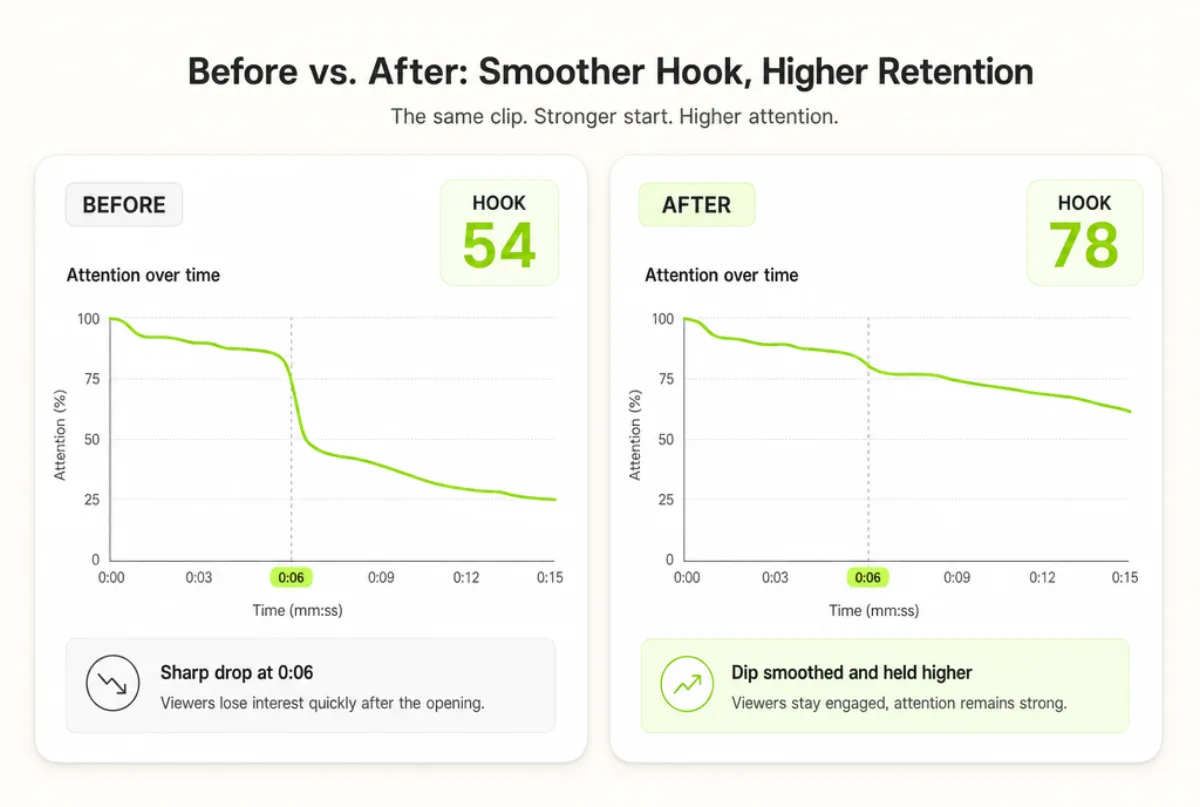 The strongest use of a predictor is relative: recut the weak beat, then compare the two reads side by side.
Run that loop on enough clips and you build an instinct for what stops a thumb — and that instinct outlasts the tool.
🎯 Where it fits in your workflow
A predictor isn't a separate ritual. It belongs in the gap between "the cut feels done" and "I hit publish" — where most creators stop checking and start hoping.
Slot a quick read into that gap and a one-way gamble becomes a cheap, reversible decision: scan, find the weak second, recut, scan again, then post.
That's the spine of a real pre-publish testing workflow.
For the honest boundary of what's knowable before posting, see how to tell if a video will go viral before you post.
And because the same hook doesn't always travel, TikTok vs Reels vs Shorts covers where reads diverge by platform.
⚠️ Honest by design
A predictor is only useful if you trust it, and trust comes from transparency: a published methodology, scores that trace to real signals, and plain statements of where the model is weak.
That's the standard Scrollproof holds itself to. It predicts creative strength from your footage and never promises reach or revenue.
It also deletes your clip shortly after analysis, and never runs face recognition.
The honest version of this category isn't the one that promises the most. It's the one that draws a clear line between what it can measure and what you want to hear — and stays on the right side of it.
Frequently Asked Questions
Can a virality predictor guarantee my video will go viral?
No, and any tool that claims it can is overpromising. Virality depends on your account, timing, the algorithm, and luck — none of which live in the file.
A predictor improves your odds by catching weak spots; it can't promise an outcome it can't see.
How is a virality predictor different from analytics?
Analytics are a post-publish autopsy — they tell you what already happened.
A predictor is a pre-publish diagnostic that reads the creative before anyone sees it, so you can recut while you still can.
What does a virality predictor actually measure?
Signals in the footage: hook strength, hold rate, an attention curve, and visual attention.
These come from real computer-vision and audio analysis — saliency, motion, scene cuts, audio energy, face presence — blended into a transparent composite.
Is the score a real prediction of views?
No. It's a creative-strength signal, not a view count.
It estimates how the video is built, not how it will perform. A well-built clip has better odds, but odds aren't outcomes.
How should I use the score to improve a video?
Treat it as a diagnostic and a comparator, not a verdict. Ask "which second is the score reacting to?" then recut that beat.
Run both versions through the same tool and compare — the relative read beats any single number.
Want to see what an honest virality read looks like on your own clip? Scan one free — three scans, no card.
Stop guessing. Scan the clip.
Drop a short video and get Hook Strength, Hold Rate, a second-by-second attention curve, and a real attention heatmap — in about a minute. First scans are free.