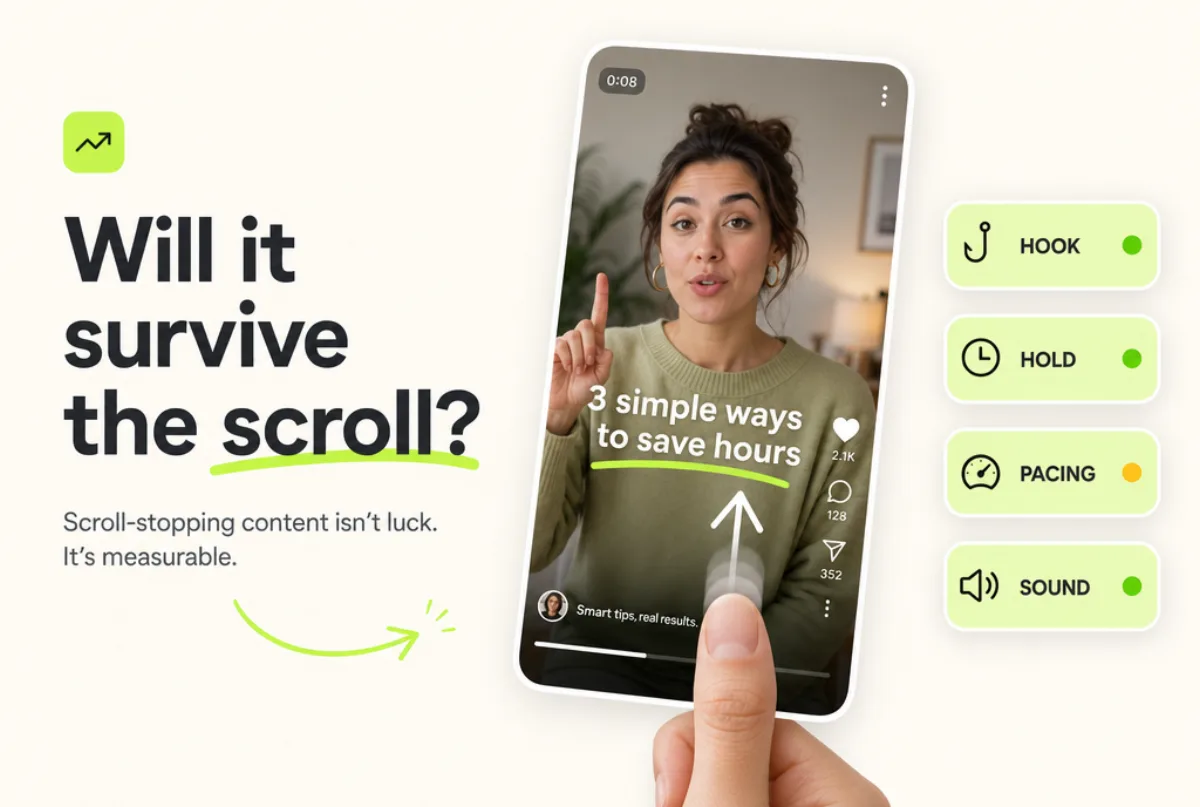
TikTok vs Reels vs Shorts: Does the Same Hook Work Everywhere?
The same clip can stop the scroll on one app and sink on another. What's the same, what differs, and how to read one cut for all three.
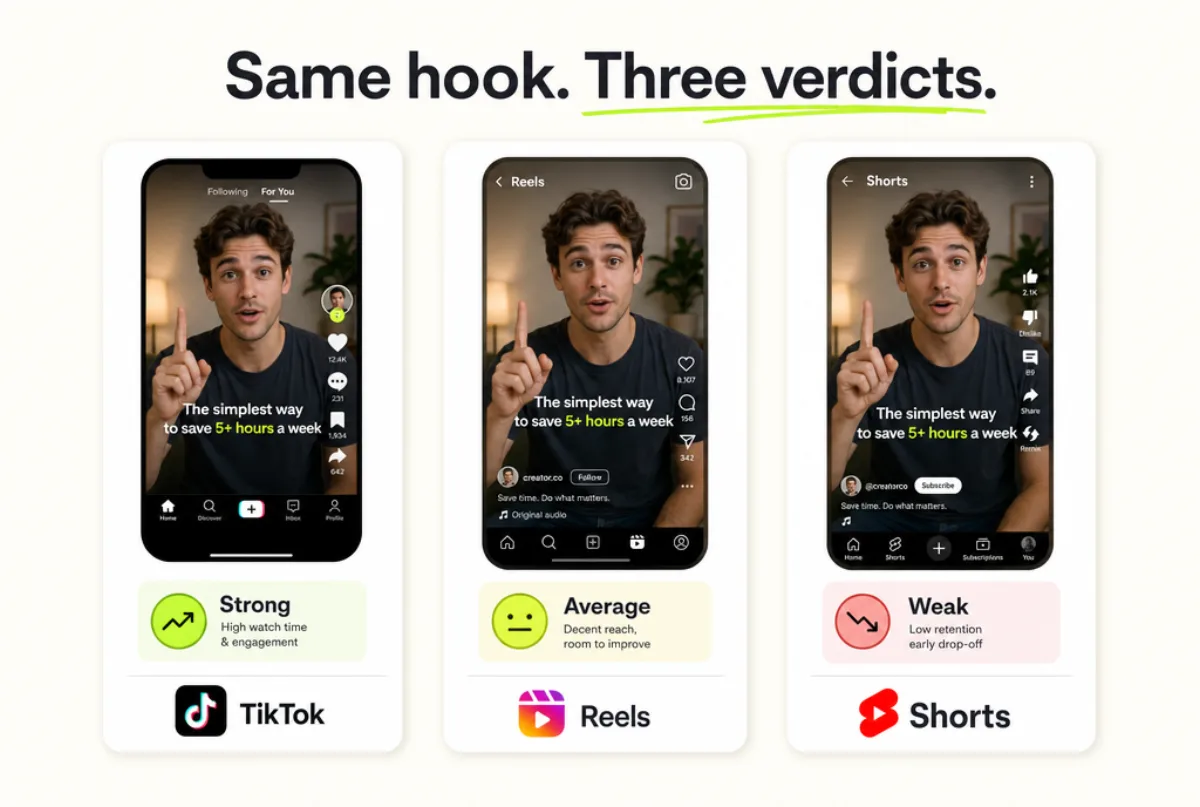
One render, three uploads — that's the dream.
But the same cut can stop the scroll on TikTok and quietly sink on Shorts.
TL;DR — The fundamentals are identical across all three feeds. The margins differ — and that's where a borderline clip is won or lost. Fix the universals first, then tune three platform dials.
🧠 What's identical everywhere
Strip the branding and all three feeds run on the same physics of attention.
A thumb is already moving. You get a fraction of a second to stop it, a few seconds to justify the stop, and the runtime to pay it off.
Three jobs decide whether a clip travels — on every app:
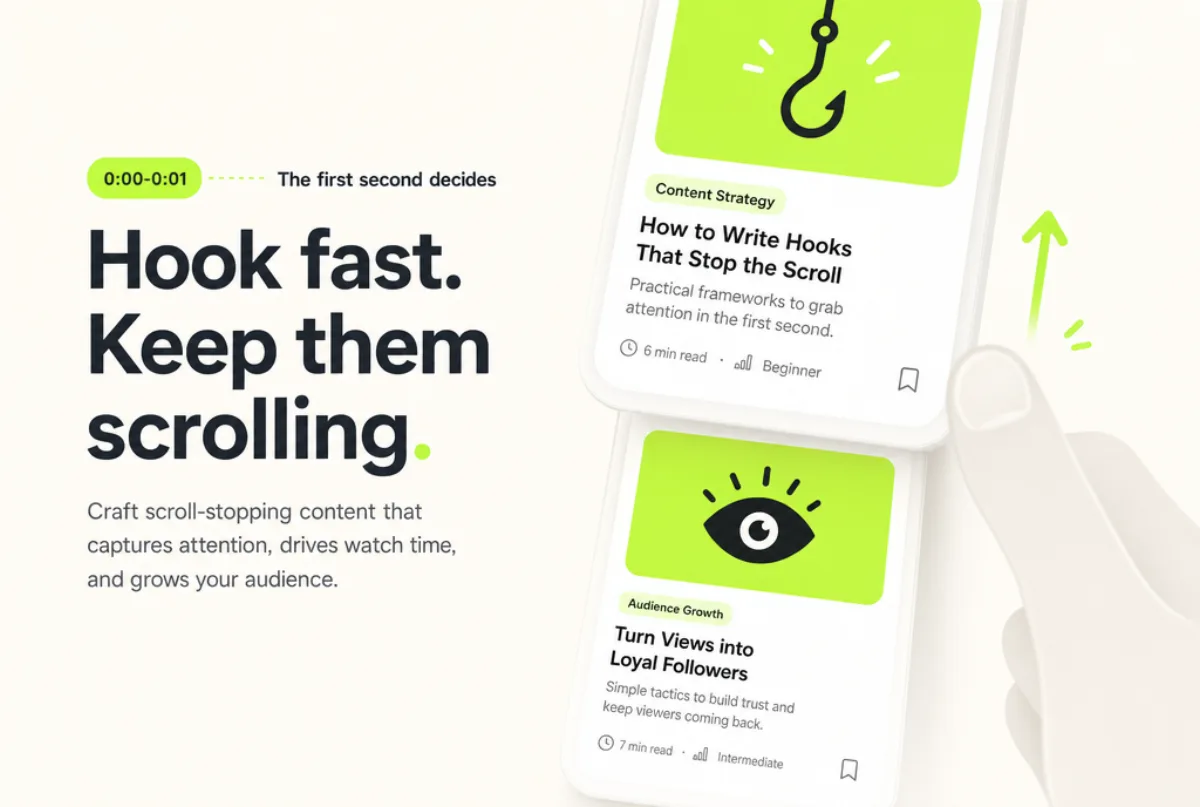
- Interrupt the scroll in the first second. Not "start well." Interrupt. The viewer didn't choose you; the feed served you mid-swipe. The first second is the whole negotiation.
- Survive the middle without a sag. Most clips don't lose people at the hook. They lose them at the first dead beat after it.
- Make the payoff worth the time. A hook writes a check. The ending cashes it or bounces it.
If a clip fails these three, no platform saves it. A clever caption can't rescue a flat open; a trending sound can't rescue a saggy middle.
Worth separating two ideas people blur: stopping the scroll and keeping someone are different jobs with different fixes — see hook vs. hold.
Each platform weights them differently.
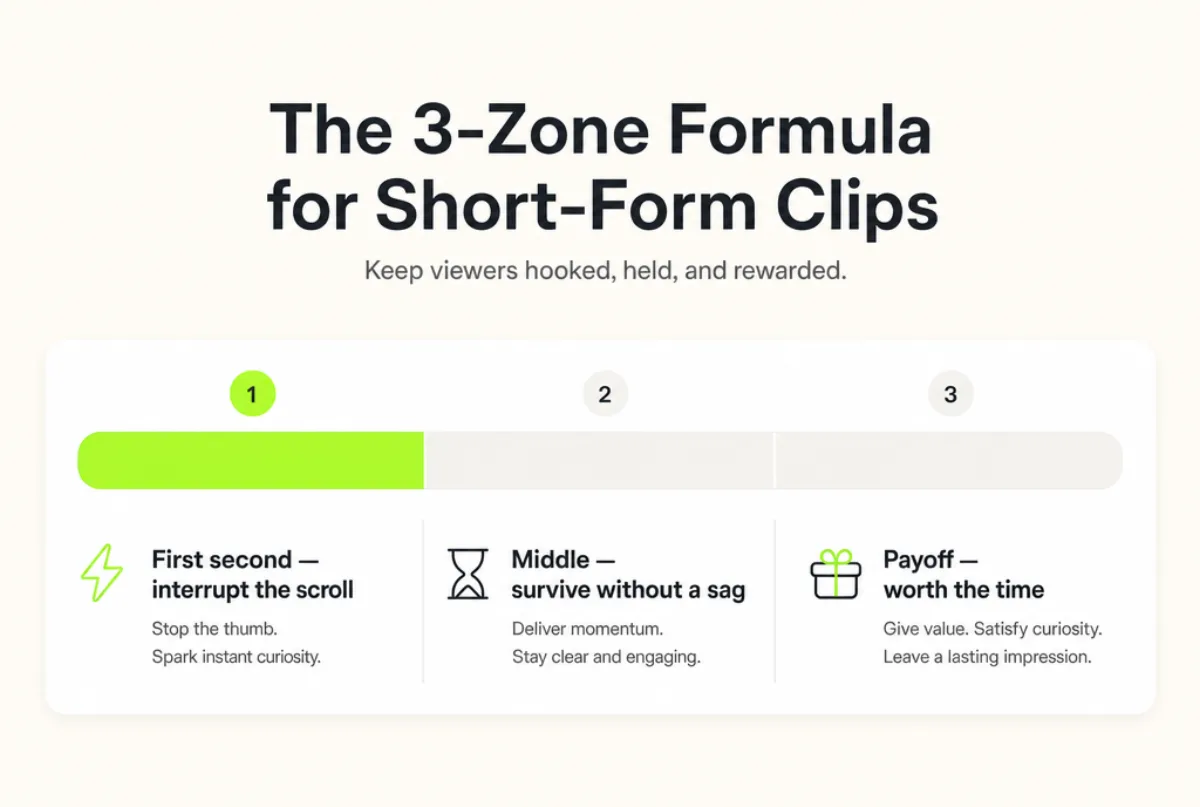 The three jobs are universal. What changes per platform is how heavily each is weighted.
🎯 Where the three actually differ
Algorithms reword themselves every quarter. The viewing context of each app is stable — and context is what shifts the margins.
| Platform | Toughest margin | What it punishes | The dial to tune |
|---|---|---|---|
| TikTok | The first beat | A late or buried hook; dead audio in second one | First-beat intensity |
| Reels | The opening frame | Low polish, weak cover frame | Cover frame + shareability |
| Shorts | The payoff | Over-promise, swipe-away | Promise-to-payoff ratio |
TikTok — the most ruthless first beat
TikTok leans hardest on raw watch behavior: how much people watch, rewatches, early bails.
The audience scrolls fast and forgives nothing in the open. A hook buried 2 seconds in often dies before it arrives.
Sound-on behavior is strongest here, which cuts both ways. If you optimize one thing for TikTok, make the very first beat carry weight on its own.
Instagram Reels — the cover frame matters sooner
Reels viewers carry higher polish expectations from the rest of Instagram.
A muddy, cluttered, or low-contrast open reads as "low quality" faster here — even with identical content underneath.
Reels also weighs saves and DM shares. A clip people forward to a friend can travel even with unremarkable completion.
The underrated detail: the cover frame — the still in the grid and discovery — often gets seen before the video plays.
If your strongest visual moment isn't also a viable cover frame, you're leaving reach on the table.
YouTube Shorts — more patience, higher payoff bar
Shorts viewers carry over from long-form, so they grant a beat or two more before deciding. But two things tighten the screws:
- The dominant negative signal is the swipe-away. Flick past fast and reach collapses.
- Shorts cares whether you stay in the feed afterward, so the payoff bar is higher. An over-promise churns hard.
One genuinely different property: Shorts content can resurface weeks or months later, while fast-feed clips live or die in days.
That rewards evergreen ideas over same-day trends.
The order of your priorities shifts by platform, but the checklist doesn't. Strengthen the universal fundamentals first. Tune the three platform dials second.
👁️ The opening frame: one still, three jobs
The single frame that opens your clip does a different job on each app — which is why "it looked fine to me" is an unreliable check.
- TikTok: the first frame of a fast judgment.
- Reels: it doubles as the discovery thumbnail.
- Shorts: it has to prevent a swipe.
What helps on all three is the same: a frame the eye can resolve instantly.
This is the domain of visual saliency — where attention gets pulled before any conscious decision. A frame with one clear subject and strong contrast wins the half-second; four competing things lose it.
So ask the platform-shaded question: in the first glance, is there one thing to look at — and is that thing the point?
If yes, the frame travels. If no, it's most exposed on Reels and Shorts.
📈 Why you can't A/B test your way there
The obvious move is "post it three ways and see." It has a structural problem: by the time you have retention data, the clip is already live and has spent its best distribution window.
You can't un-post a weak open.
Worse, the three apps don't show your clip to comparable audiences at comparable times. You end up comparing a Tuesday-morning Reels cohort to a Friday-night TikTok cohort and calling the gap "platform fit."
The move that works: read the clip's structure before posting and ask which platform's margin it's weakest against.
Structure is knowable in advance — first-beat timing, frame contrast, second-one audio, where attention sags. We unpack why a post-hoc number is the wrong tool for a pre-publish question in what a virality score can — and can't — tell you.
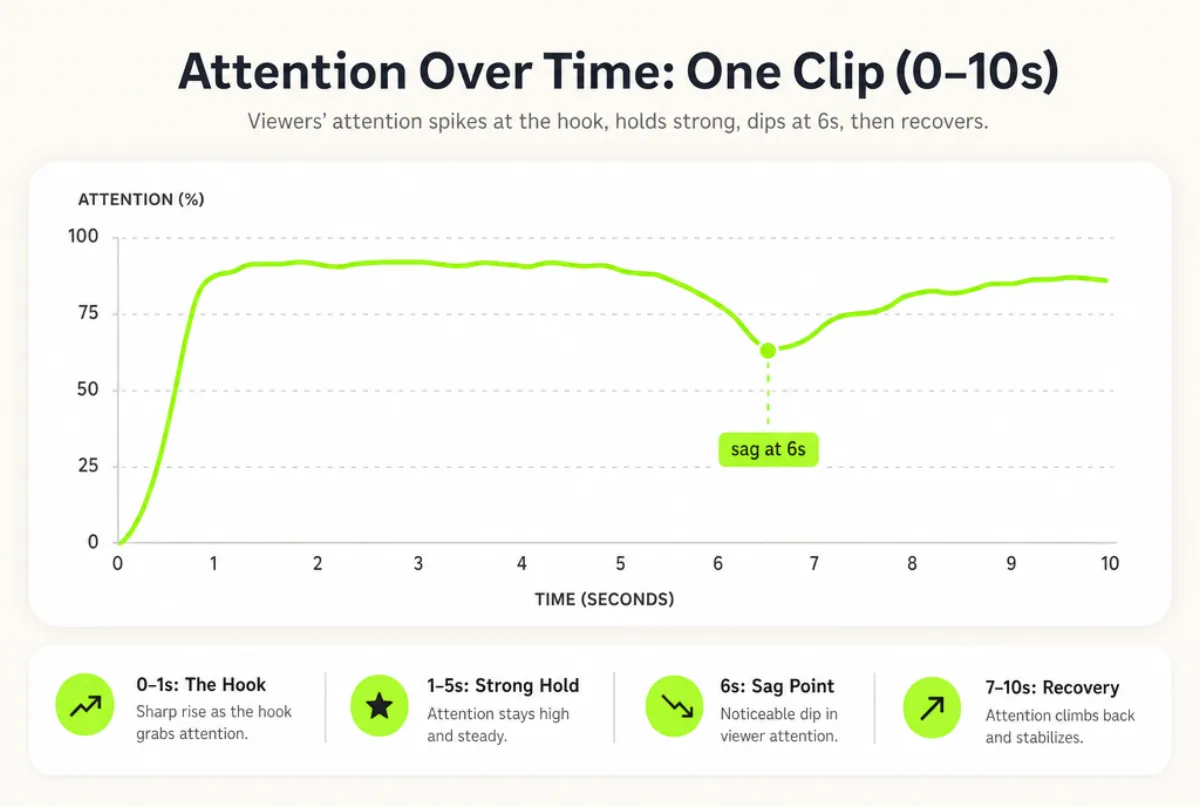 One clip, read against three thresholds. The 6-second sag clears Shorts and Reels but slips under TikTok's higher watch-time bar — a fix you'd rather make before posting.
✅ How to read one cut for all three
This pre-publish read doesn't give a "good/bad" verdict. It diagnoses which margin a cut is exposed to.
Learning to read an attention curve makes most of this fast.
| Signal | Riskiest on | Quick fix |
|---|---|---|
| Weak or late first beat | TikTok | Move the strongest moment to second one, or cold-open on it — fixing a weak open |
| Cluttered, low-contrast opening frame | Reels (Shorts swipe risk) | Pick a frame with one focal point and high contrast |
| Thin payoff for the promise | Shorts | Deliver more, or promise less |
| Dead or generic audio in second one | TikTok | Let audio reinforce the hook, not decorate it |
| A sag in the middle | All (worst on TikTok) | Cut the dead beat or add a pattern change |
Run those 5 and you'll usually find the same export is fine for two platforms and exposed on one. That's the output: not "rebuild three times," but "safe on Reels and Shorts, needs a tighter first beat for TikTok."
⚠️ When the same cut is safe — and when it isn't
Cross-posting the identical export is the right call more often than specialists admit.
Strong early first beat, clean high-contrast frame, audio that lands in second one, payoff that matches the promise — it clears every margin. Three separate edits would be wasted effort.
You need a platform-specific open only when a clip clears the bar narrowly and is exposed on exactly one margin. The common cases:
- Slow-burn open, gorgeous but late → tighter cold-open for TikTok, keep the original for Shorts.
- Best visual lands mid-way → re-cut so that moment is the opening/cover frame for Reels.
- Trend-dependent → don't lean on it for Shorts, where the resurfacing tail rewards evergreen.
The decision is always margin-driven, never reflexive.
💡 How Scrollproof reads the margin for you
This is the exact read Scrollproof is built for.
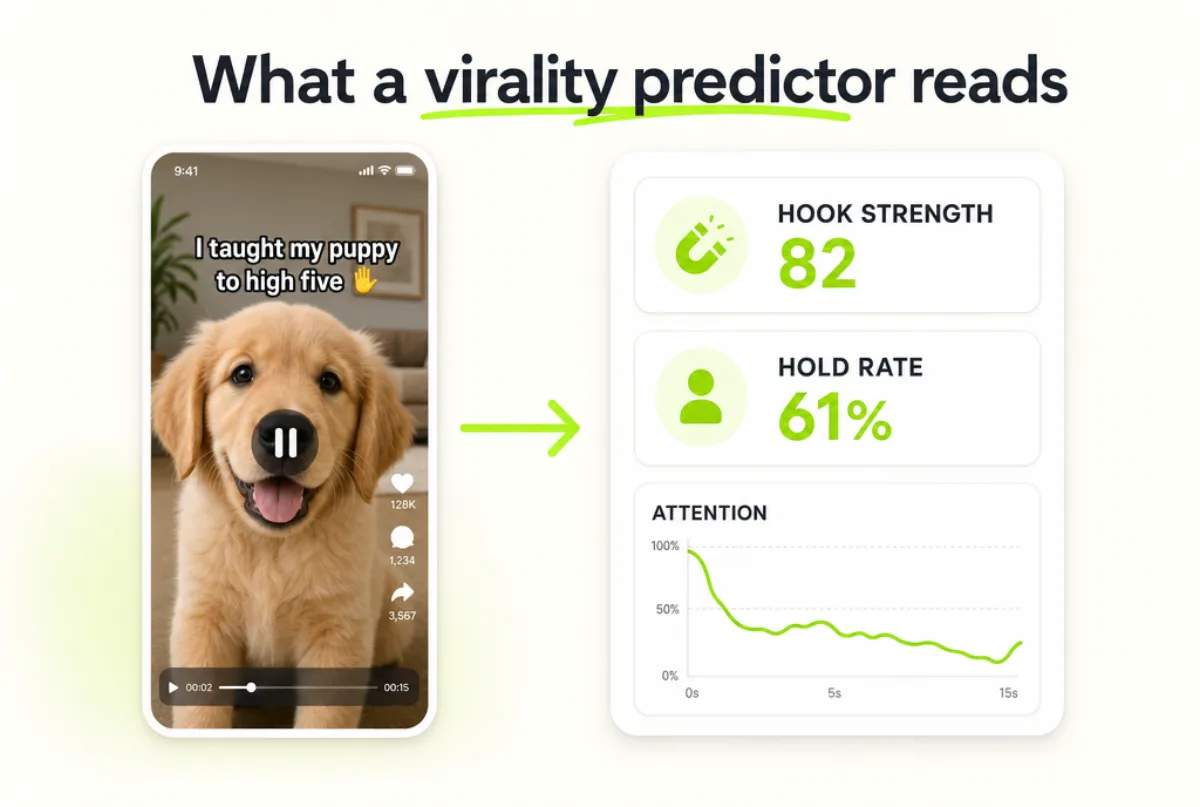
It analyzes the actual footage — not a caption or a guess — and scores Hook Strength, Hold Rate, an attention curve, and a visual-attention heatmap from real computer-vision and audio analysis.
In practice: you see where the eye lands in your opening frame, how strong the first beat is, where the curve sags, and whether the audio carries the open — the exact signals that map to the three platform margins.
It predicts creative strength, not guaranteed views.
No tool can promise a number, and any that does is selling you something.
But creative strength is the part you can still change before you publish. For a repeatable version, see the pre-publish testing workflow.
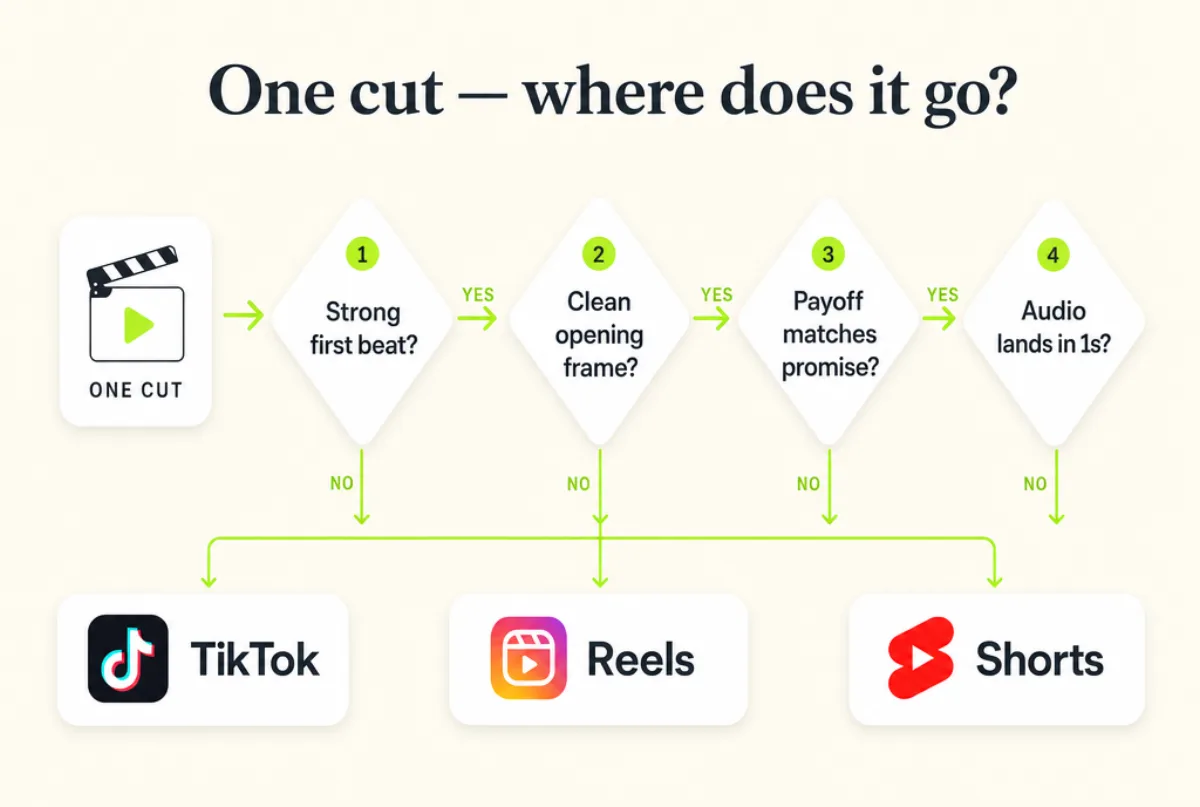 The cross-post decision is margin-driven: pass every check and ship one export everywhere; fail one and fix only that platform's open.
Frequently Asked Questions
Can I post the exact same clip to TikTok, Reels, and Shorts?
Often, yes. If it has a strong early first beat, a clean high-contrast opening frame, audio that lands in second one, and a payoff that matches its promise, a single export is fine.
You only need a platform-specific open when the clip clears the bar narrowly and is exposed on one margin.
Which platform has the harshest hook requirement?
TikTok, in practice. Its discovery leans hardest on raw watch behavior and the audience scrolls fastest, so a late or buried first beat is punished more.
The usual single fix: move the strongest moment into second one.
Why does the opening frame matter more on Instagram Reels?
On Reels the opening still often doubles as the cover frame shown in discovery before the video plays, so a weak frame loses the click before the hook gets a vote.
Reels viewers also carry higher polish expectations.
What's different about YouTube Shorts specifically?
Shorts tolerates a slightly longer setup, but the dominant negative signal is the swipe-away, and it cares whether viewers stay in the feed afterward — so the payoff bar is higher.
Shorts content can also resurface weeks later, rewarding evergreen ideas.
How do I know which platform a clip is weak for without posting it three times?
Read the clip's structure before posting instead of testing live — by the time you have data, the best distribution window is spent.
Diagnose first-beat timing, frame contrast, second-one audio, and where the curve sags. A tool like Scrollproof reads exactly those signals from the footage.
Stop guessing which platform a cut is exposed to. Scan one free and see the hook, hold, attention curve, and heatmap before you post.
Stop guessing. Scan the clip.
Drop a short video and get Hook Strength, Hold Rate, a second-by-second attention curve, and a real attention heatmap — in about a minute. First scans are free.