How to Tell If a Video Will Go Viral Before You Post It
You can't predict views before posting. You can measure if a clip is built to survive the scroll. Here's the pre-publish read that does it.
You can't know a video will go viral before you post it.
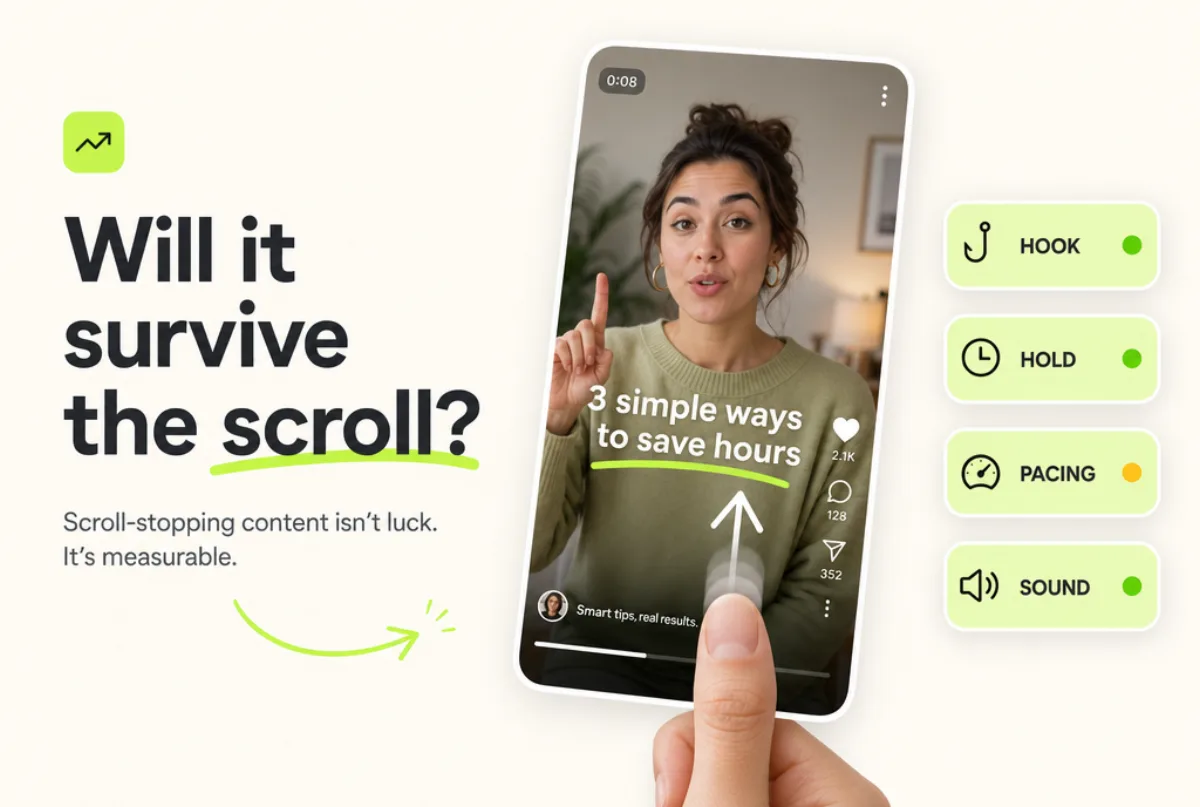
But you can know if it's built to survive the scroll — and that part lives entirely in the file.
TL;DR — Virality = creative + account + timing + algorithm + luck. Four of those five live past the publish button. The fifth — the creative — is measurable now, and it's the only part a recut can change.
🧠 What's actually knowable before you post
Split the question and the mystery disappears.
- In the file: the open, the structure, the pacing, the sound. A fresh viewer reacts to this in the first second. So can a careful read.
- Downstream of publishing: your followers, posting time, what's trending, how the feed distributes, who shares. None of it exists while the file is on your drive.
A pre-publish read is upstream of all of it. It's precise about the creative and honestly silent about the rest — and that silence is a feature.
(Long version: what a virality score can and can't tell you.)
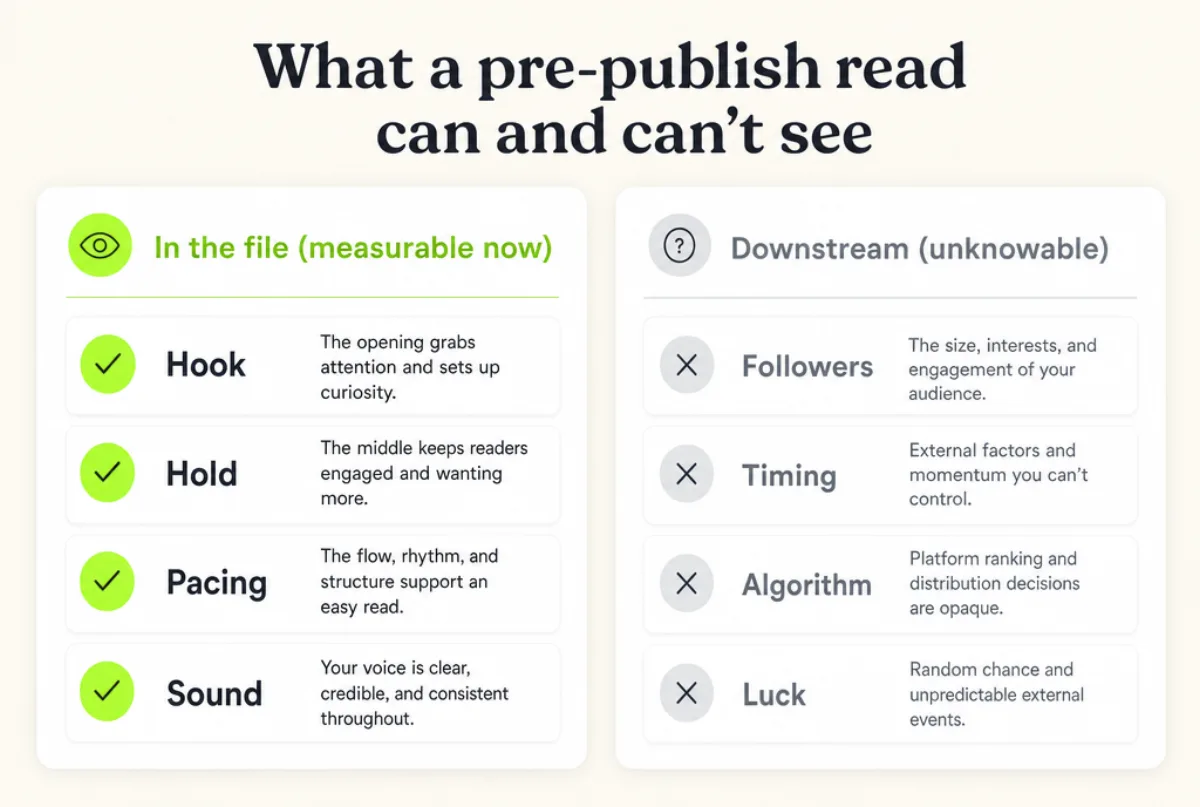 A pre-publish read sees the creative — and nothing downstream of publishing.
So the real question gets narrow and answerable: is this clip built to win the part of the game that's in my hands?
🎯 Signal 1 — Does the first second interrupt a departure?
A scrolling viewer is already leaving, thumb in flight. Your opening frame's only job is to interrupt that departure.
Watch your first second with the sound off and ask:
- Is there a pattern break, an open loop, or an instant stake — before any words land?
- Or does second one just say "hi guys, so today I want to talk about"?
If the payoff is at 0:04, you have a hook problem, not a content problem — and they're fixed in completely different ways.
Go deeper: the first second is the whole negotiation, the slow-start failure mode in why most short videos die before three seconds, and the practical repair in fixing a weak open.
⏱️ Signal 2 — Does attention hold through the middle?
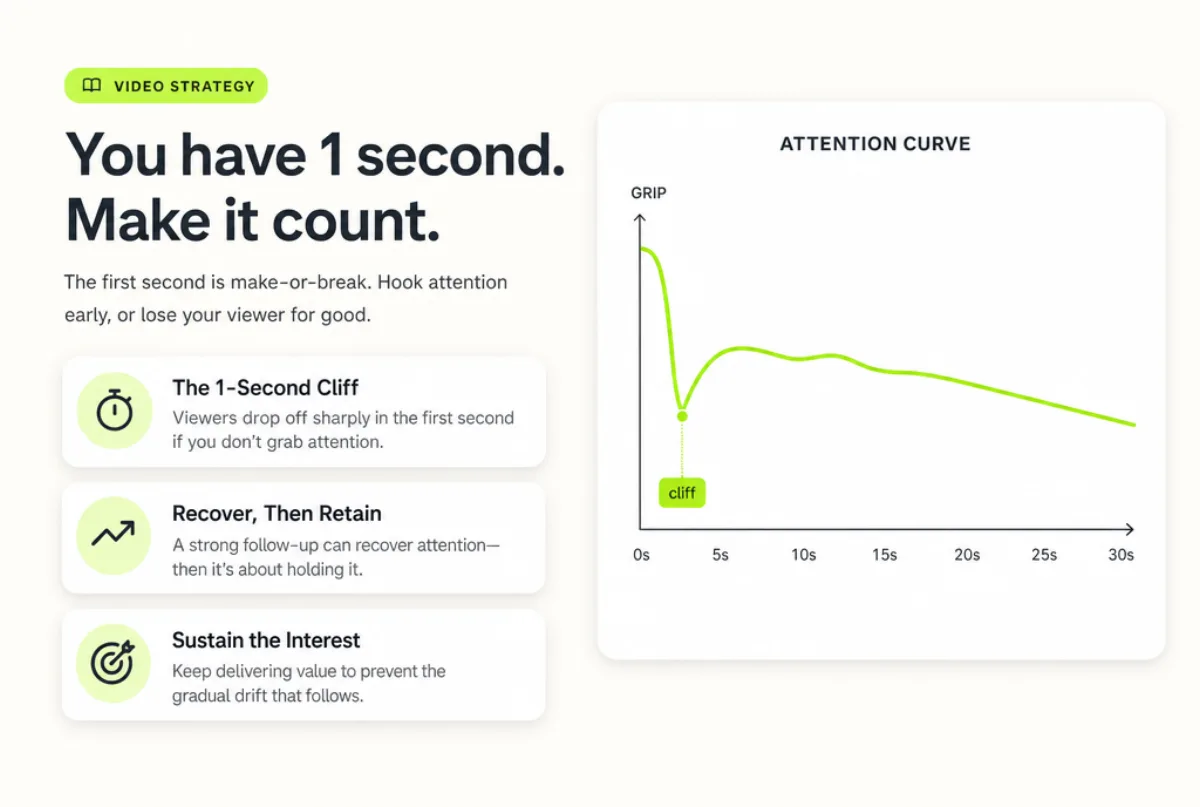
Most short videos don't die at the start. They die in the sag around the halfway mark — after the hook spends its energy, before the payoff arrives.
The open worked, the viewer leaned in, then nothing reset their attention. So they drifted out where you thought you'd won them.
The fix for the sag is a re-hook: a new visual, a sharp question, a hard cut, a beat change — something that resets attention before it drifts.
Map where your clip goes visually and sonically quiet, and assume that's where viewers leave. Because it is.
Stopping the scroll and keeping someone are two different skills — pulled apart in hook vs. hold.
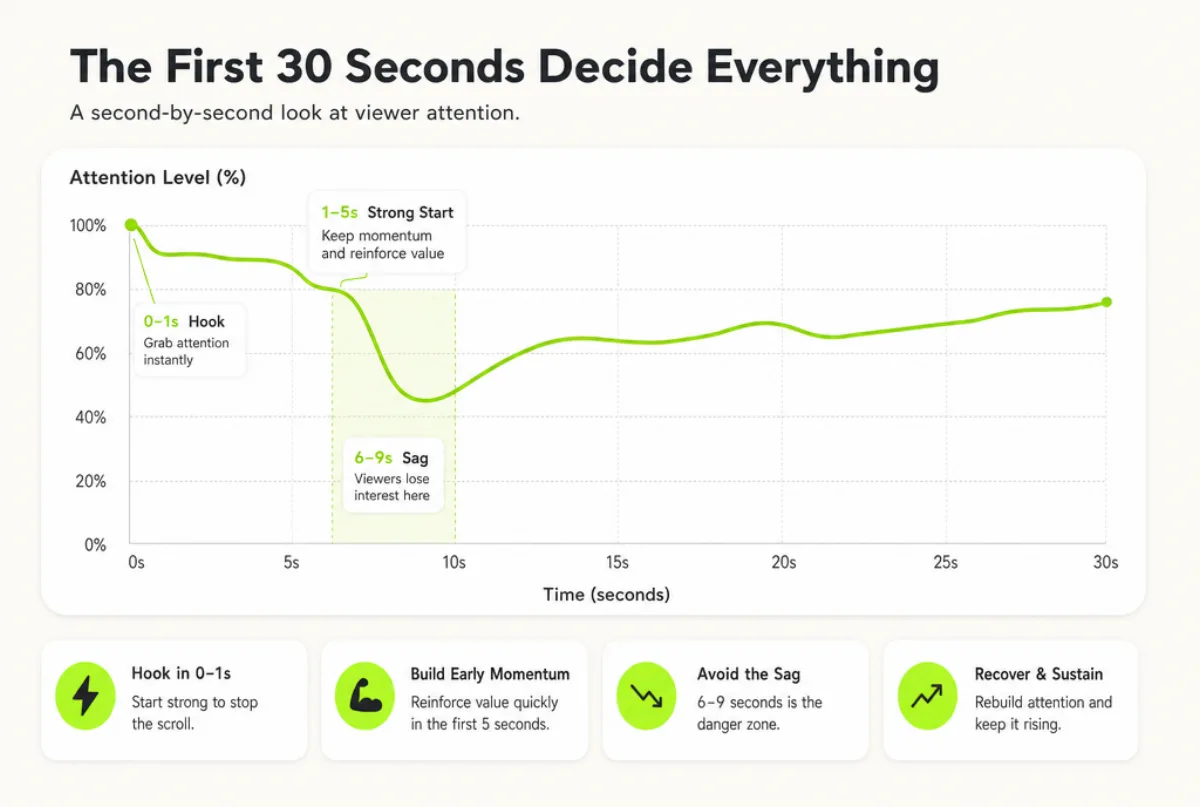 The hook gets you in the door; the sag around the midpoint is where most attention is actually lost.
The cleanest way to see this is a second-by-second view of where attention strengthens and leaks — an attention curve.
Learning to read one is covered in how to read an attention curve like a diagnostician. The dips are your edit list.
✂️ Signal 3 — Is the pacing doing any work?
Flat pacing reads as "nothing is happening." And "nothing is happening" reads, instantly, as "skip."
You don't need frantic, machine-gun cuts — that's a different failure, where energy is high but nothing is legible.
You need change: a zoom, a new angle, a motion shift, a reframed subject every couple of seconds, so the eye always has something new to land on.
Gut check: scrub your timeline and mark every spot where the frame is static for more than two or three seconds. Each mark is a place the eye has run out of reasons to stay.
Pacing and cuts: the hidden engine of watch time breaks down what "enough change" actually looks like.
🔊 Signal 4 — Is the sound pulling, or is it dead air?
Silence in the first second is one of the most common silent killers — and it's invisible in the edit, because you're watching with intent and the volume up.
- Pulling: a confident voice, a strong beat, a well-placed sound in the opening moment. A retention signal.
- Dead air: flat, hesitant, or absent audio. Quiet permission to scroll.
This matters even on muted autoplay — the cut rhythm and captions are doing the audio's job, and if they're slack, there's nothing to hold the ear when sound kicks in.
Audio does more retention work than most creators credit, and it's the channel they edit last.
More in sound is half the video (and the half you're probably ignoring).
None of these four are about taste or production value. A polished video with a buried hook loses to a scrappy one that interrupts the scroll. Quality is judged after the interrupt — it can't save an open that never stopped the thumb.
👁️ Where the eye actually goes in your frame
Even when all four signals look right, there's a quieter failure: the most important thing in your frame isn't the most attention-grabbing thing in your frame.
The eye is pulled toward contrast, motion, and faces — often before the viewer reads anything.
So if your hook text sits in a low-contrast corner while a bright background element hogs the center, attention lands on the wrong thing in the half-second that decides everything.
Align what you want seen with what the eye is pulled toward.
When those diverge in the first second, a great script can still feel like it "didn't land" — and no caption tweak fixes a problem that lives in the composition.
The mechanics are worth understanding before you trust the read: how the eye decides where to look (before you do).
📈 Turn the read into a number you can act on
Eyeballing the four signals beats posting blind. But it's slow and structurally biased.
You made the clip. You've watched it forty times. You already know the payoff lands at 0:06, so your brain supplies patience a first-time viewer never will.
That blind spot is the hardest thing to overcome by eye, because it's invisible from the inside.
That's the gap a pre-publish diagnostic fills, and the reason Scrollproof exists.
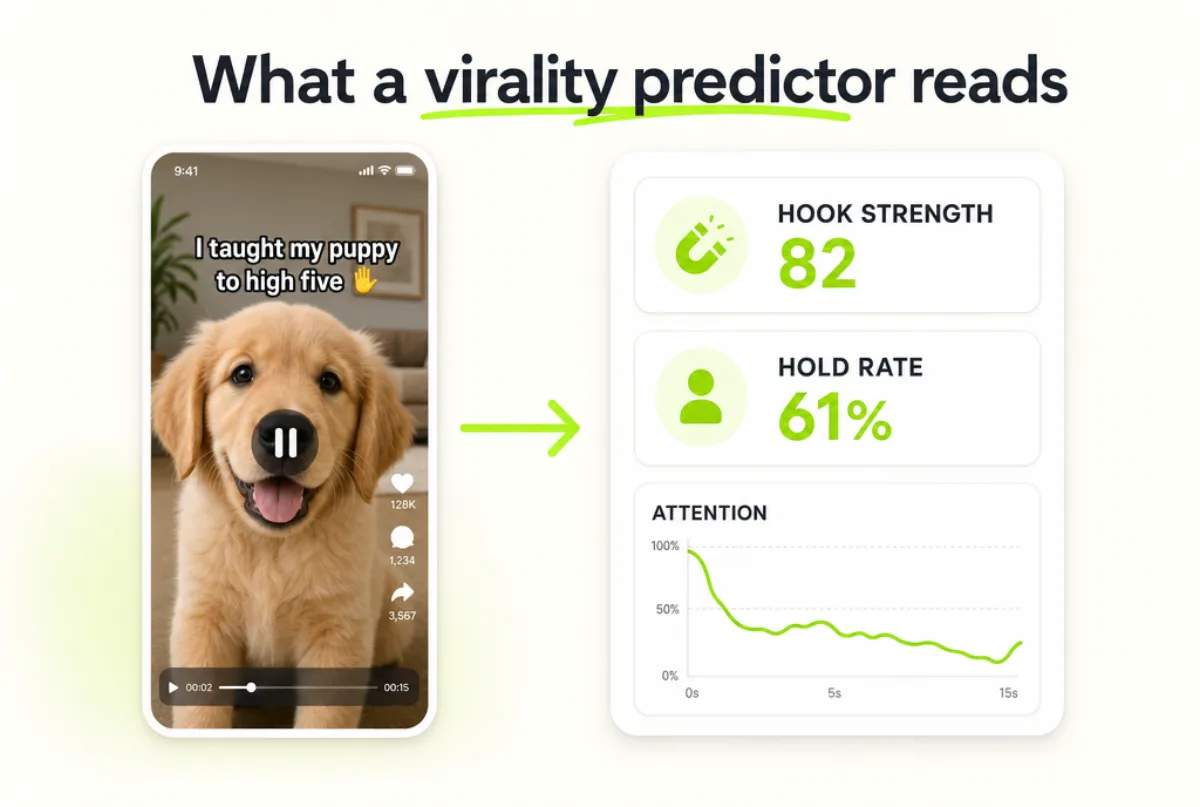
It reads the footage — saliency, motion, scene cuts, audio energy, face presence — and returns the four signals as scores:
| Signal | What the read tells you | Quick fix if it's weak |
|---|---|---|
| Hook Strength | Does second one interrupt the scroll? | Front-load the stake; cut the intro |
| Hold Rate | Does the middle survive the sag? | Add a re-hook at the dip |
| Attention curve | Where, second by second, you leak | Edit the lowest second first |
| Saliency heatmap | Is the eye landing on your subject? | Raise contrast; move text to the gaze |
It's a creative diagnostic, not a crystal ball. It predicts whether a clip is built to hold attention and flags the weak seconds.
It doesn't promise views — no honest tool computed from a file on your drive can. The boundaries: what is a virality predictor (and what it can't do).
Use any score relatively. "This cut reads stronger than that cut" is far more trustworthy than any single absolute number — and it's the use that actually changes your edits.
💡 The pre-publish loop that compounds
Knowing the four signals is the easy part. The creators who improve fastest run a small, cheap loop the most times before it counts. Treat every clip as a test:
- Cut a version — the one you'd actually post.
- Read the hook, hold, and pacing — by eye or by score, cold, before familiarity blinds you.
- Fix the single weakest second — one change, so the difference is attributable.
- Re-cut and compare side by side — did the weak beat improve, and did anything else get worse?
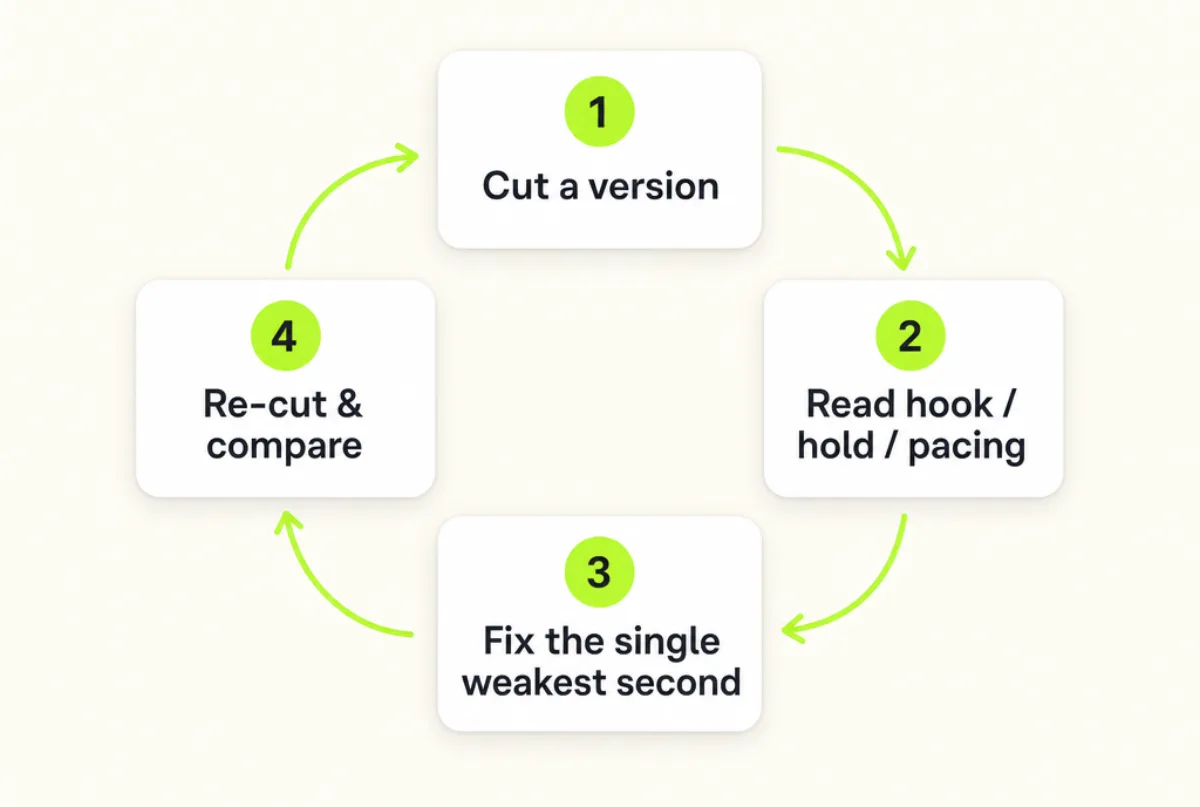 The loop is cheap enough to run on every cut — that's the whole point.
The discipline is changing one thing at a time. Tweak the open, music, and pacing all at once and you've learned nothing transferable.
Change one beat, re-read, attribute the difference — and you've banked a lesson that carries to every future video. The full version: test before you publish — a workflow, not a gut check.
Do this ten times and something shifts. You stop guessing.
You start to recognize a thumb-stopping open before you post — the closest thing to "knowing if it'll go viral" that honestly exists.
Frequently Asked Questions
Can any tool actually predict if a video will go viral?
No — not honestly. Virality depends on your account, timing, the algorithm, and luck, none of which exist before you publish.
A tool can predict creative strength: whether the clip is built to stop the scroll and hold attention. That's real and measurable, but it's about how the video is built, not how it will perform.
What should I check before posting a short video?
Four things, in order: does the first second interrupt the scroll before any words land; does attention hold through the sag in the middle; is the pacing changing every couple of seconds; and is the sound pulling rather than sitting as dead air.
Most preventable failures are one of these four.
Why do videos with a great hook still flop?
Because stopping the scroll and keeping someone are different skills. A strong hook gets the viewer in the door, but if nothing re-hooks them around the midpoint, they drift out in the sag before the payoff.
See hook vs. hold.
Isn't watching my own video enough to judge it?
It's a good habit, but structurally biased. You've seen the clip dozens of times, so you supply patience a first-time viewer won't.
A cold read — a fresh person, or a diagnostic that reads the file directly — catches weak opens your eyes have stopped noticing.
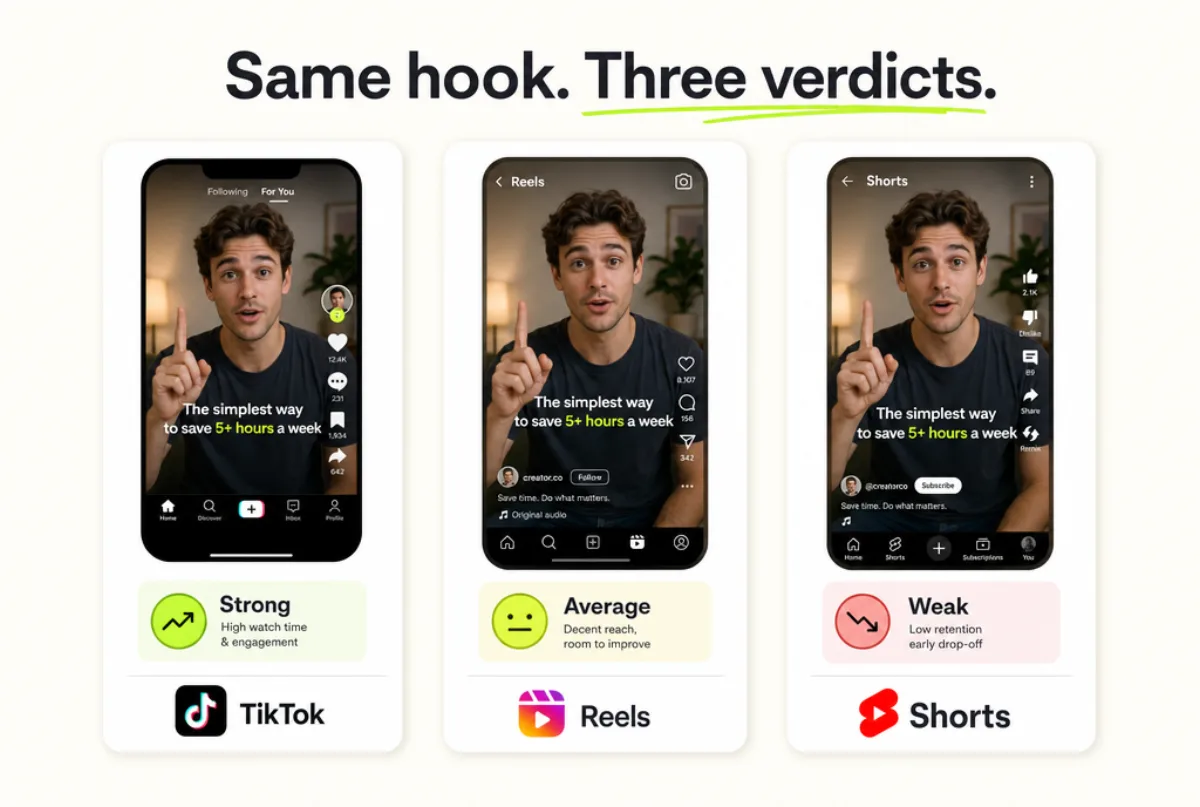
Does the same hook work on TikTok, Reels, and Shorts?
The underlying read is the same, but platform norms differ in pacing and how fast the feed moves.
Test the cut where you'll post it — more in TikTok vs Reels vs Shorts.
Want to see it on a real clip? Scan one free and read the curve before you post.
Stop guessing. Scan the clip.
Drop a short video and get Hook Strength, Hold Rate, a second-by-second attention curve, and a real attention heatmap — in about a minute. First scans are free.