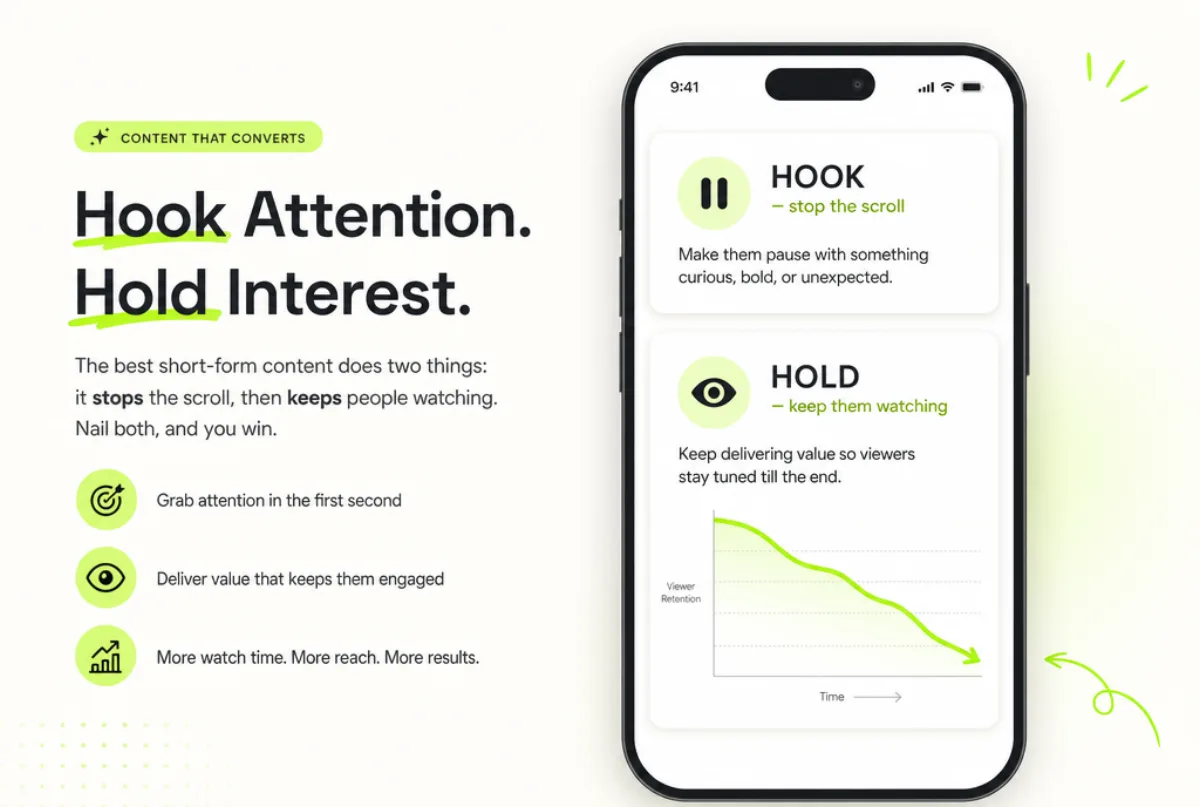
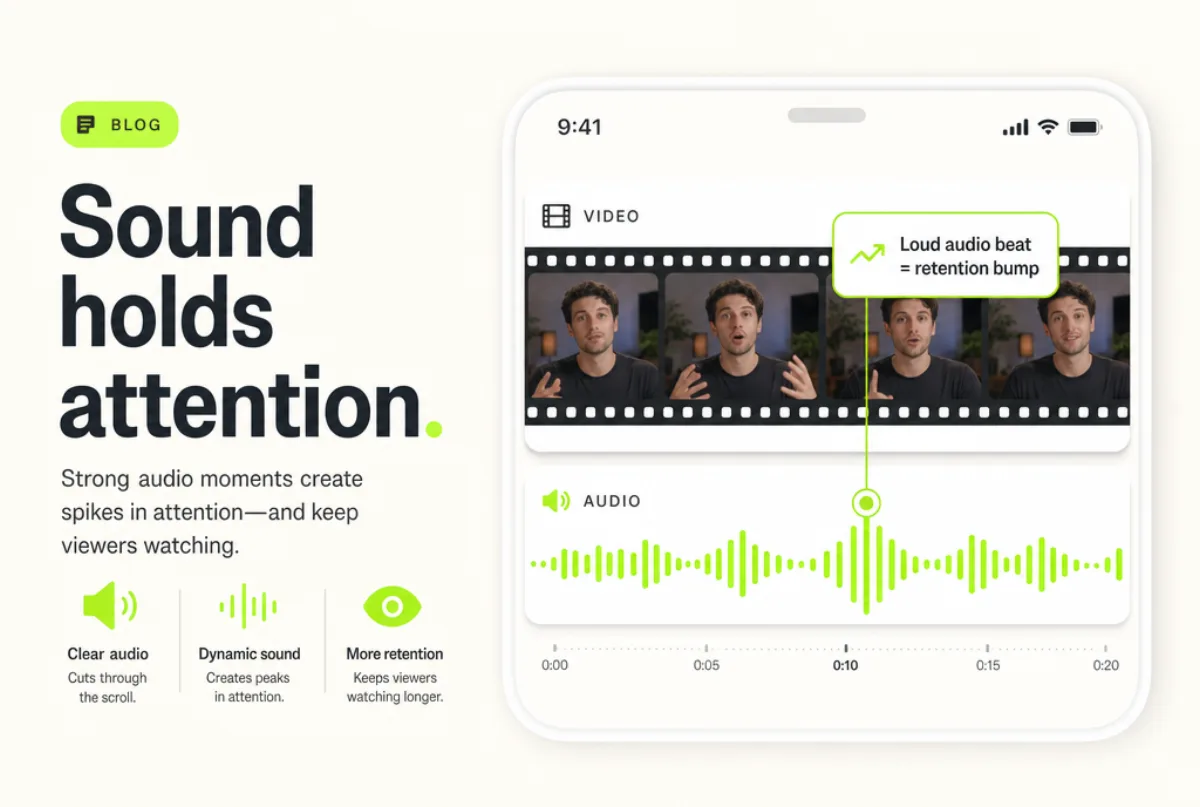
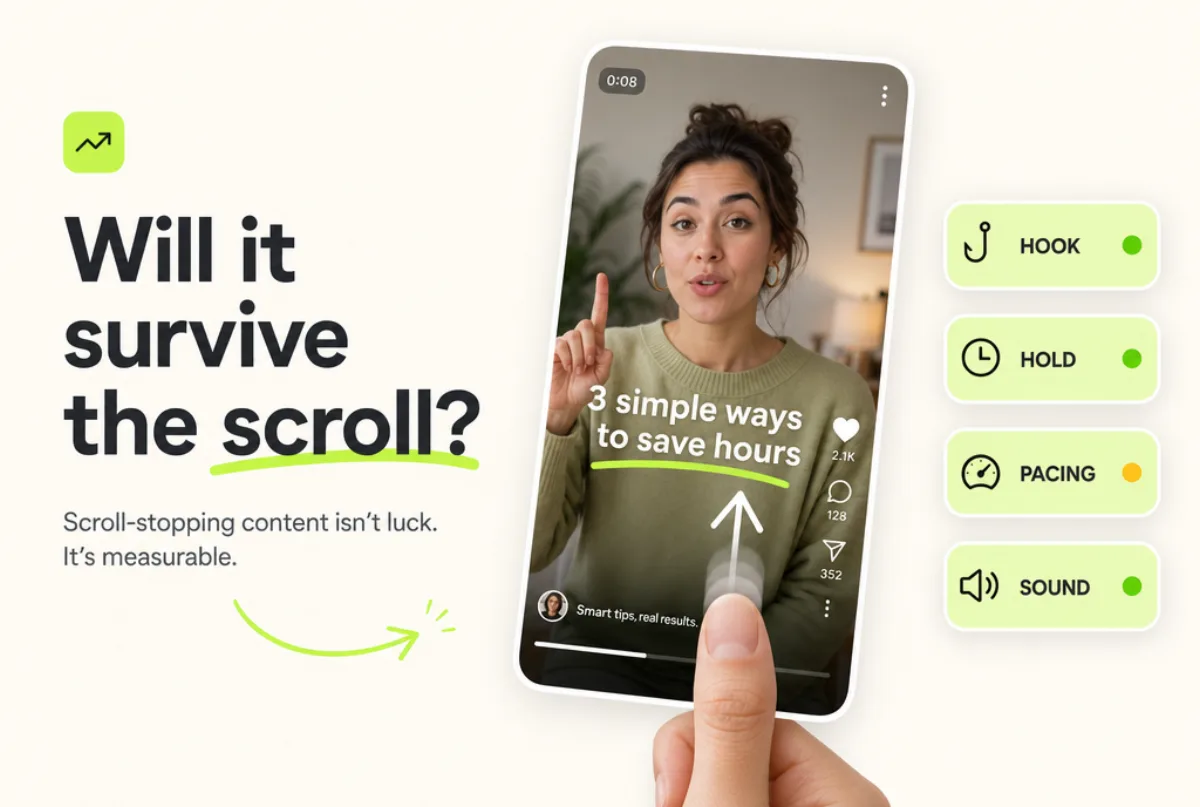
Why Most Short Videos Die Before Three Seconds
Short videos lose most of their audience in the first 3 seconds. Here's which exits are unavoidable noise — and which ones you can fix before you post.
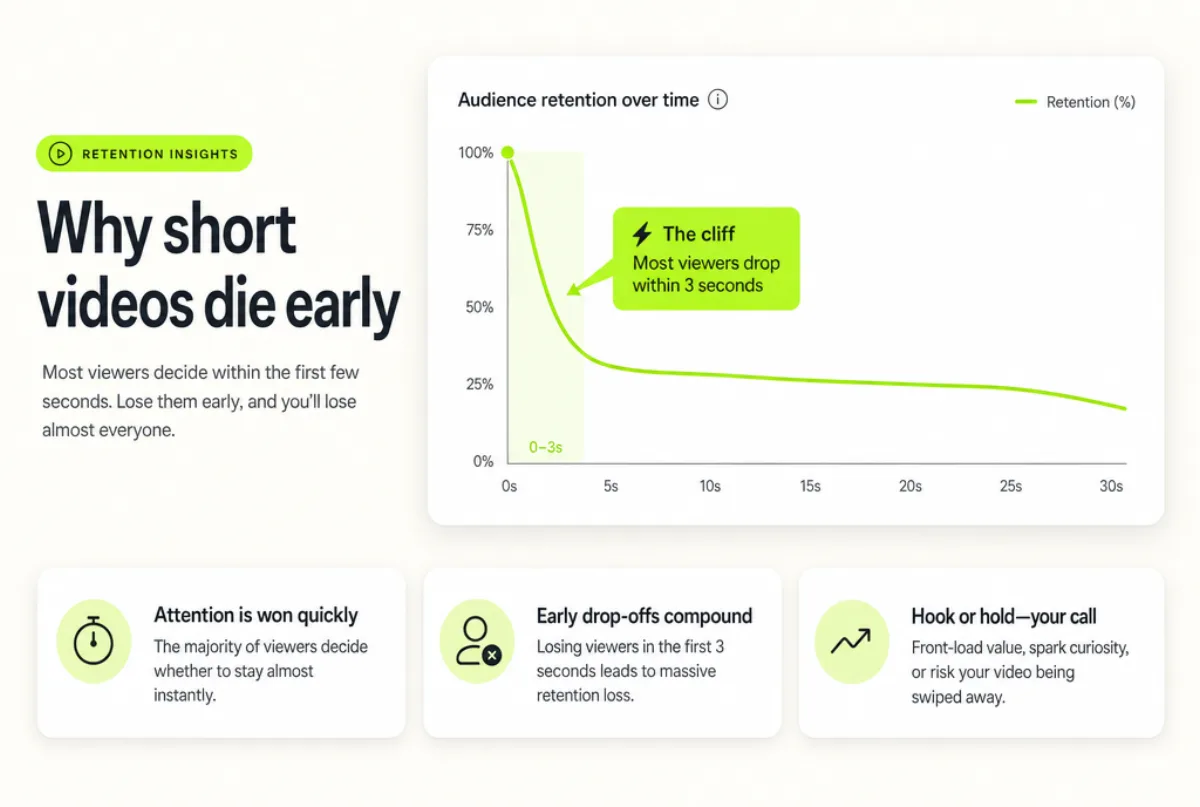
Open any short video's retention graph and you'll see the cliff: a near-vertical drop in the first few seconds, then a gentle slope for whatever's left.
That cliff is where your audience goes.
TL;DR — Most of the drop happens in the first 3 seconds. Some of it is unavoidable noise; the rest is a weak open or a broken promise — and those you can fix before you post.
🧠 The viewer is already leaving
A scrolling viewer isn't sitting still, waiting to be impressed. Their thumb is in motion, and the default — what happens if your video does nothing — is that they leave.
So you're not earning attention. You're interrupting a departure that's already underway.
The clock starts before your first word, your logo, your "real" content.
This is why polished videos die in second one and scrappy clips sometimes don't.
Production quality gets judged after the interrupt — it can't save an open that never stopped the thumb. More on that in The First Second Is the Whole Negotiation.
❌ The three kinds of early exit
Not every early exit is a rejection. They have different causes and need different fixes.
Lumping them together is how you end up fixing the wrong thing.
| Exit type | What it means | Can you fix it? | Where to look |
|---|---|---|---|
| Accidental arrival | Feed mis-delivered the clip | Mostly no — it's noise | Don't chase it |
| Failed interrupt | The open didn't stop the thumb | Yes | The first 1s |
| Broken promise | The next beat didn't pay off the hook | Yes | Seconds 1–3 |
- Accidental arrival — never your audience. They registered "not for me" instantly and left. Correct behavior; chasing it to zero is a trap.
- Failed interrupt — might have been right for the video, but the open didn't stop them. A hook problem in a retention costume. This is where almost all the leverage lives.
- Broken promise — the open worked, but the next beat didn't deliver. A structure problem, not a hook problem.
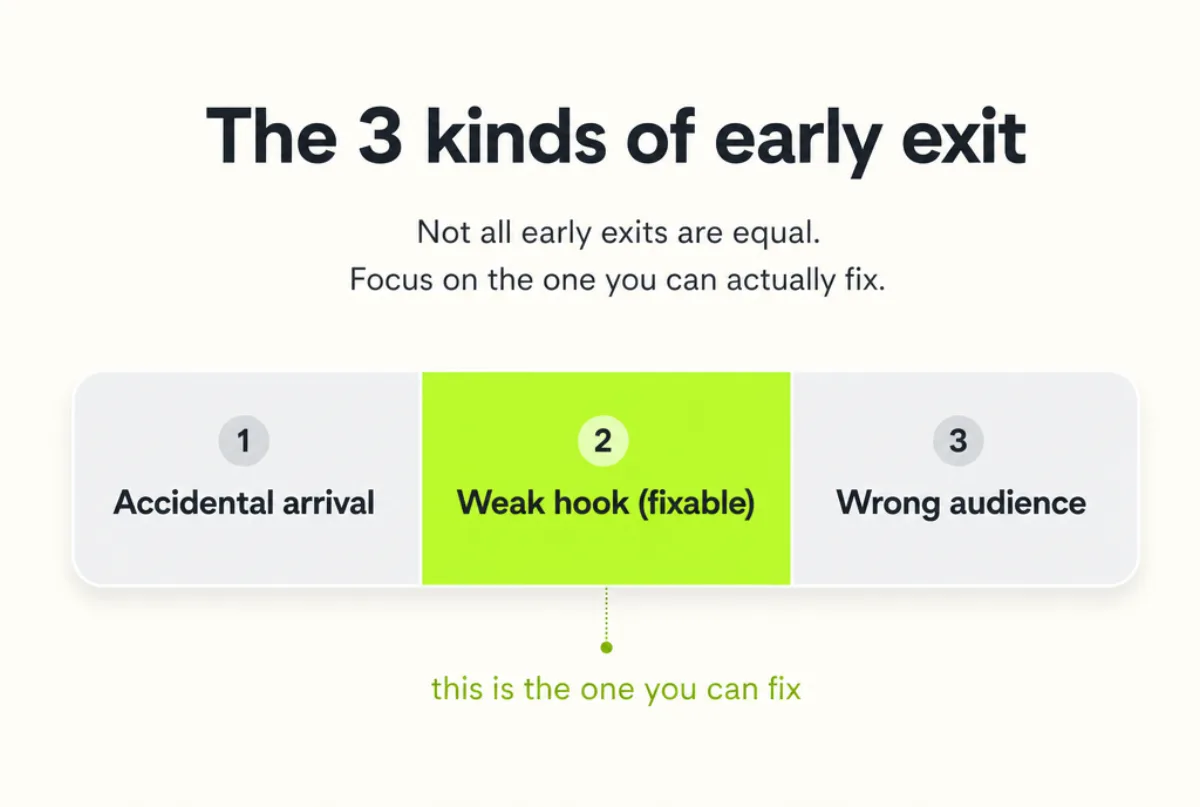 Only the failed interrupt and the broken promise respond to effort — the accidental arrival is noise.
Two of these exits are levers. One is weather. Spend your effort on the levers.
⏱️ Why three seconds, specifically
Nothing magic about the number.
The first three seconds just happen to hold two separate decisions, back to back — and either one can kill you.
- Stop or scroll — happens almost instantly, on the open. Pre-rational, made on what the viewer sees.
- Stay or go — a beat later, once they've stopped long enough to take in what's actually here.
A video has to survive both gates. Plenty win the first and lose the second: a great hook opening onto a flat, throat-clearing middle.
That's two gates with almost no gap between them — the difference between hook and hold, compressed into one breath.
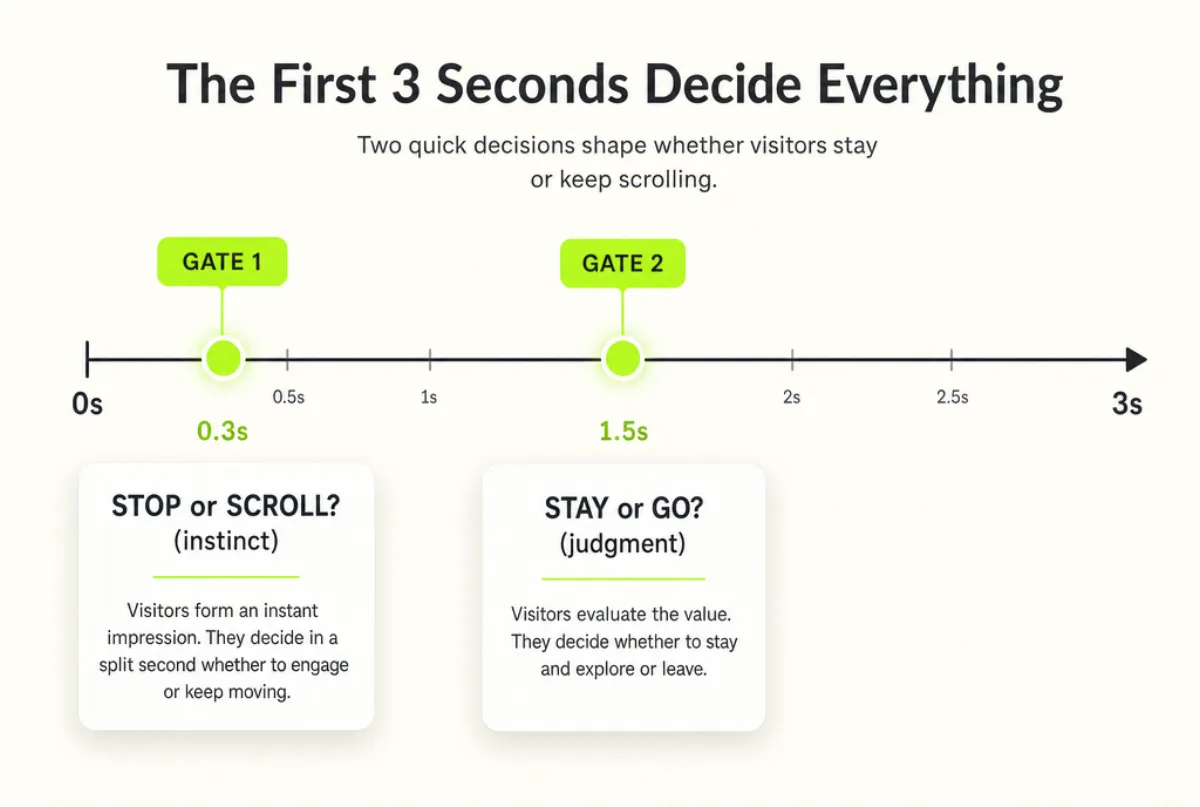 The three-second window isn't one test. It's two decisions with almost no gap between them.
👁️ Make the first frame instantly legible
Before a viewer decides whether they like your video, they decide whether they can place it.
The silent question: what is this, and is it for me? No answer in a glance, and the safe move is to swipe.
So a strong open is a legible open — the frame instantly communicates a category and a stake.
- ✅ Works: a face mid-reaction, a visible before/after, a result already on screen, an object doing something
- ❌ Fails: a logo card, a slow establishing shot, a person who hasn't started talking yet
The reason these fail is the same reason the eye snaps to them or doesn't — see how the eye decides where to look.
Quick test: freeze your first frame and ask a stranger "what's this about?"
If they can't guess, your open is making them do work the swipe does faster.
✂️ Cut the throat-clearing
The most common cause of the broken-promise exit is throat-clearing — setting up before delivering. "Hey guys, so today I wanted to talk about…"
Every word is a second the viewer waits and doesn't get what they stopped for.
The fix: start the video at the moment the value starts. Context comes later, or not at all.
- Delete your first sentence and watch it back. If the video is sharper, it was throat-clearing — leave it gone.
- Whatever the open promised, the next frame should move toward it — not toward an intro.
When the open itself is weak (not just the runway), fixing a weak open is its own craft.
It's usually about which frame you open on, not a cleverer line.
🔊 Build the hook to survive the mute
A large share of feeds scroll with sound off.
If your entire hook lives in the audio, then for those viewers your hook doesn't exist — just a silent, inert frame and a moving thumb.
Audio still matters — sound is half the video for viewers who have it on.
But the visual has to carry the hook alone, because for many it's the only thing that lands in time.
- Burn in captions, and front-load the words that matter. The first caption should tease the payoff, not introduce it.
- Make the first frames legible in silence. If muting kills the hook, the hook was never reaching half your audience.
Build it to work muted first. Let the sound make it better for everyone else.
✂️ Keep the frame changing
Even a clean open can lose the second gate to one quiet killer: a frame that doesn't change.
A static shot held too long — no cut, no zoom, no movement — reads as "nothing is happening," and the thumb resumes.
You don't need frantic editing. You need the frame to keep advancing — a new angle, a push-in, a gesture, a line of text arriving.
This is where pacing and cuts start doing retention work immediately, and a stalled frame costs the most in the first three seconds.
📈 What the curve tells you that views don't
A view count tells you that you lost people, never where. An attention curve tells you both.
- Cliff in the first second → the open. A failed interrupt.
- Cliff in seconds 1–3 → the hook-to-payoff seam. A broken promise.
- Slow, steady decline after a clean start → the open's fine, the middle thins out. A hold problem, not a hook problem.
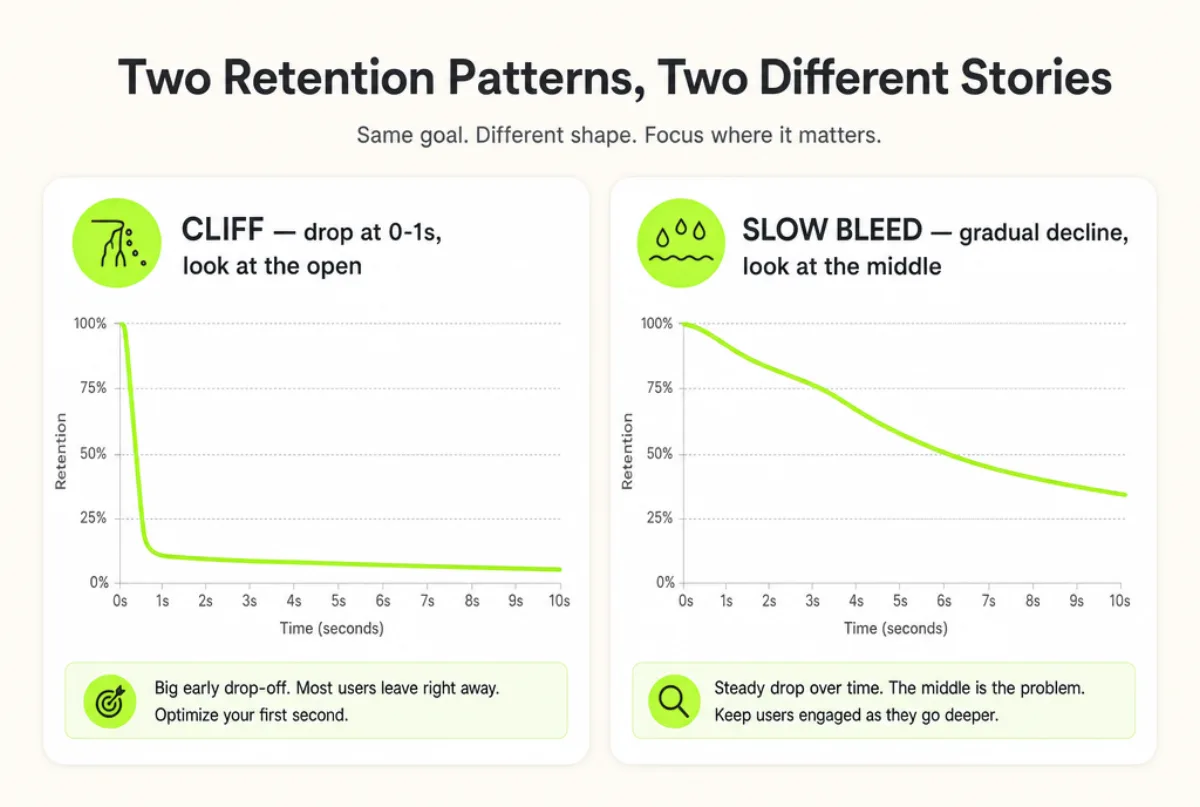 A cliff points at the open. A slow bleed points at the middle. Same low number, opposite fixes.
That's the whole case for reading a curve before you publish, not a number after. Reading the curve like a diagnostician turns an opaque verdict into a list of edits.
Be honest about the limits, though — a pre-publish curve models structural strength, not how a specific audience will feel, which is exactly what a score can and can't tell you.
✅ The three-second pre-publish checklist
The short version of a full pre-publish testing workflow, aimed straight at the cliff:
- Does the first frame interrupt? Open on your most arresting frame, not the most logical one.
- Can a stranger categorize it instantly? Freeze frame one. Blank stare means it isn't legible yet.
- Does it still work muted? Mute it. If the hook vanishes, move it into the visual and captions.
- Did you cut the runway? Delete the first sentence. If the video improved, it was throat-clearing.
- Does the second beat pay off the first? The next moment should move toward what the open promised.
- Does the frame keep changing? No static shot should read as "nothing happening" in the first three seconds.
Videos that die treat the first three seconds as preamble. Videos that live treat them as the whole show.
Frequently Asked Questions
Why do most short videos lose viewers in the first three seconds?
Those seconds hold two fast decisions — stop or scroll, then stay or go — and the scrolling viewer's default is to leave.
If the open doesn't interrupt that departure, or the next beat doesn't pay off what the open promised, they swipe before the real content arrives.
Is a steep early drop-off always a problem?
No. Some early exit is just viewers the feed mis-delivered — noise, not failure.
The exits worth fixing are the failed interrupt (a weak open) and the broken promise (an unpaid hook). Only those two respond to effort.
How do I fix a weak open without remaking the video?
Usually you don't remake anything — you start later.
Open on the most arresting frame you already have, cut the throat-clearing, make the first frame legible and muted-proof, and ensure the second beat moves toward the promise.
More in fixing a weak open.
Does the three-second rule apply to TikTok, Reels, and Shorts equally?
The physics — interrupt a departure, then pay it off — applies everywhere people scroll a feed.
The exact window and feel vary by platform, as we cover in does the same hook work everywhere.
Build for the interrupt first; tune for the platform second.
Can I see where a video loses people before I post it?
Yes — that's the point of a pre-publish attention curve.
Scrollproof models second-by-second engagement from the clip's own visuals, motion, and audio, so you can spot a cliff or dead spot and fix it.
It predicts structural strength, not guaranteed views.
Want to see your own cliff before the feed does? Scan one free and check the first three seconds against both gates.
Stop guessing. Scan the clip.
Drop a short video and get Hook Strength, Hold Rate, a second-by-second attention curve, and a real attention heatmap — in about a minute. First scans are free.